The practice
Commercial electro-optical and infrared (EO/IR) and thermal analysis, delivered as a full written report.
The work reviews the imagery and supporting data provided. The report states the findings, the basis for those findings, and what those materials can and cannot support.
Firm fixed price. Every amount on this page is a firm fixed price. Not an estimate and not a ROM.
Limits. The analysis interprets the imagery and supporting data provided. Image quality, emissivity, reflections, atmosphere, band, and a missing scale or reference limit what can be said. This is not a licensed engineering stamp. Where a price is listed, payment is for a full written report.
After payment. Email the imagery, supporting data, and a short description of the asset or the claim to lance.haney@gmail.com. Put the analysis name in the subject.
RFQ
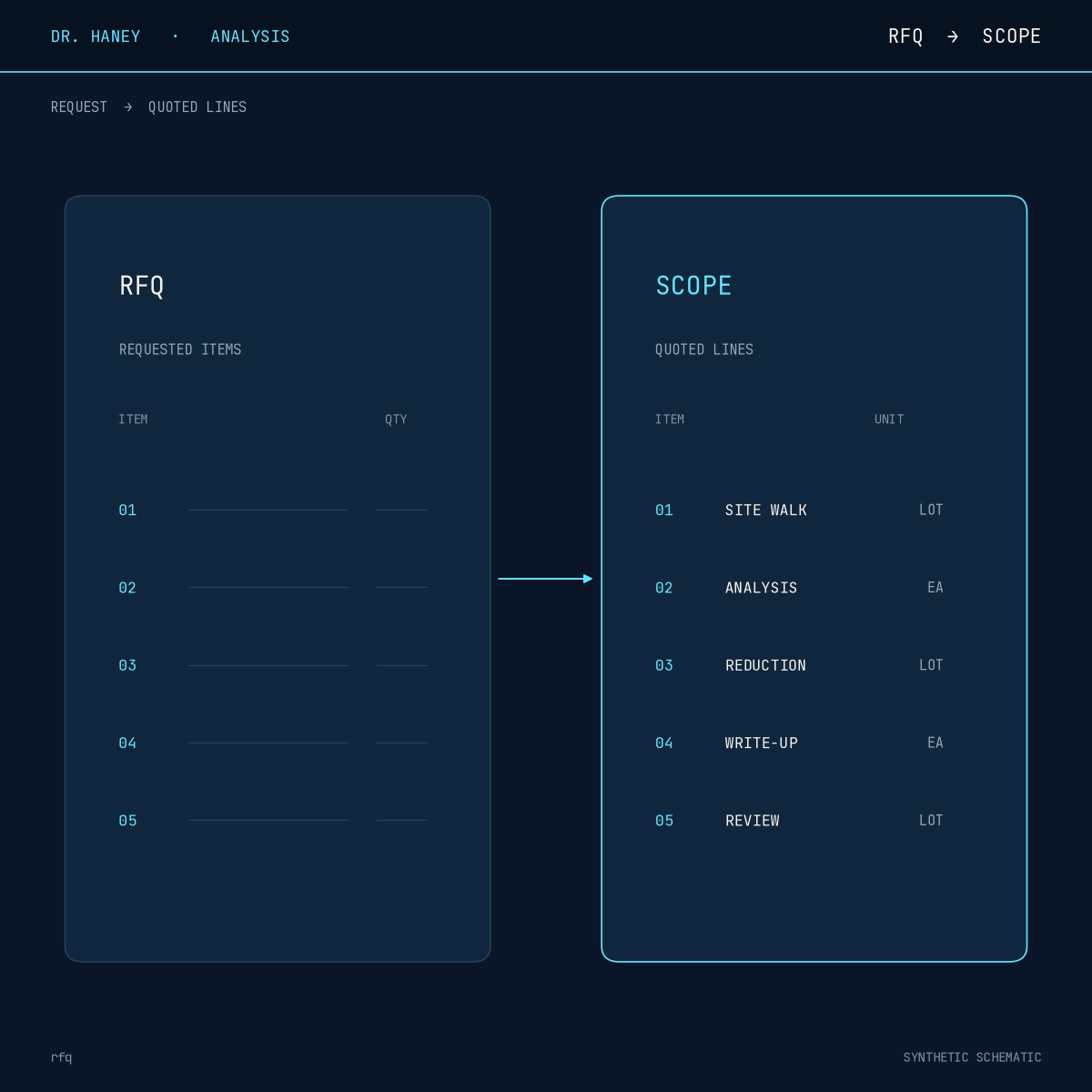
Custom jobs are quoted only when a Request for Quote (RFQ) is supplied. There is no checkout.
Nothing is measured until a quote exists. The quote states the job and its quantity, and it is limited to the request supplied.
RFP
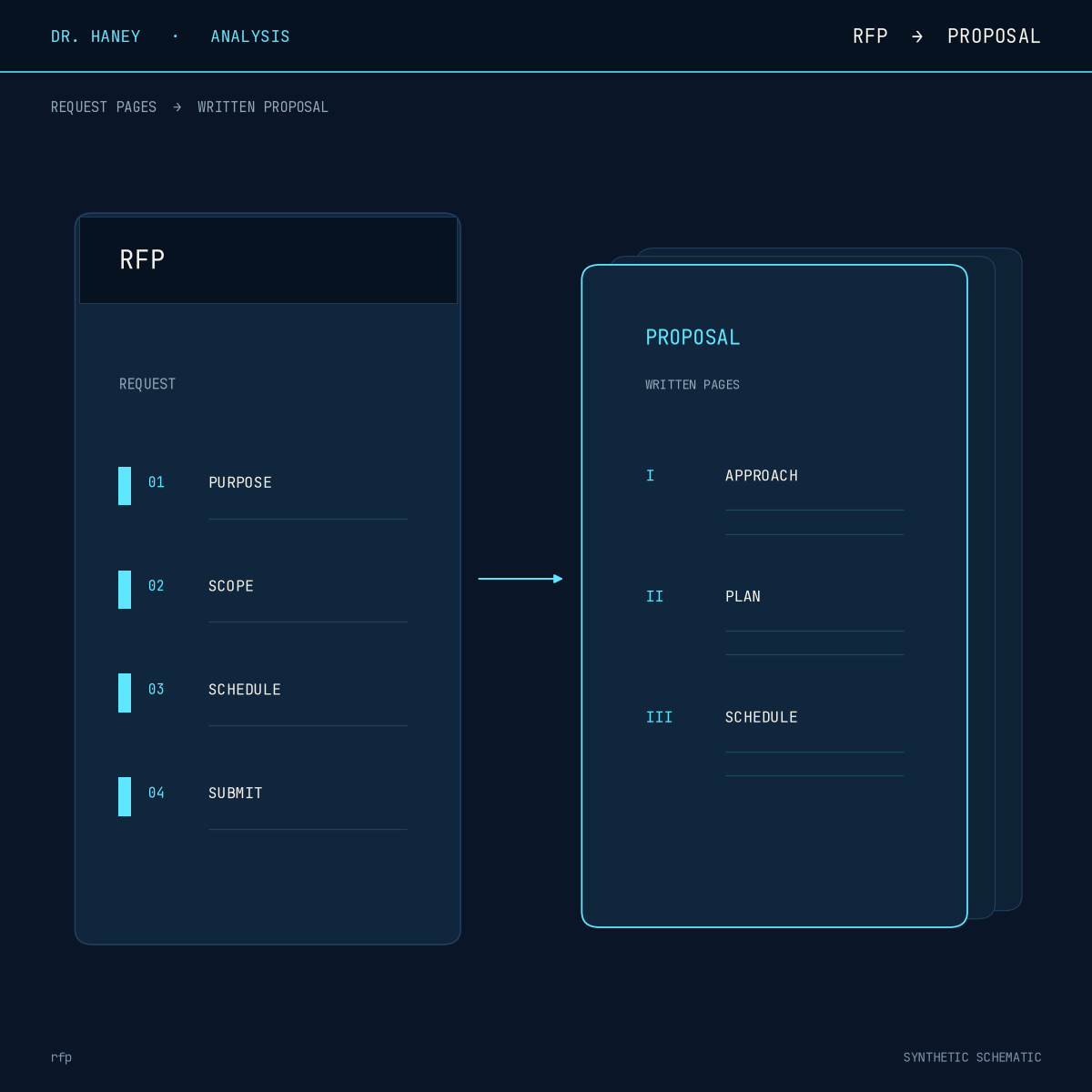
A full proposal is written and supplied when a Request for Proposal (RFP) is submitted. There is no checkout.
Nothing is measured in the proposal itself. The proposal states the work and the quantities to be supplied, and it is limited to the request submitted.
RFI
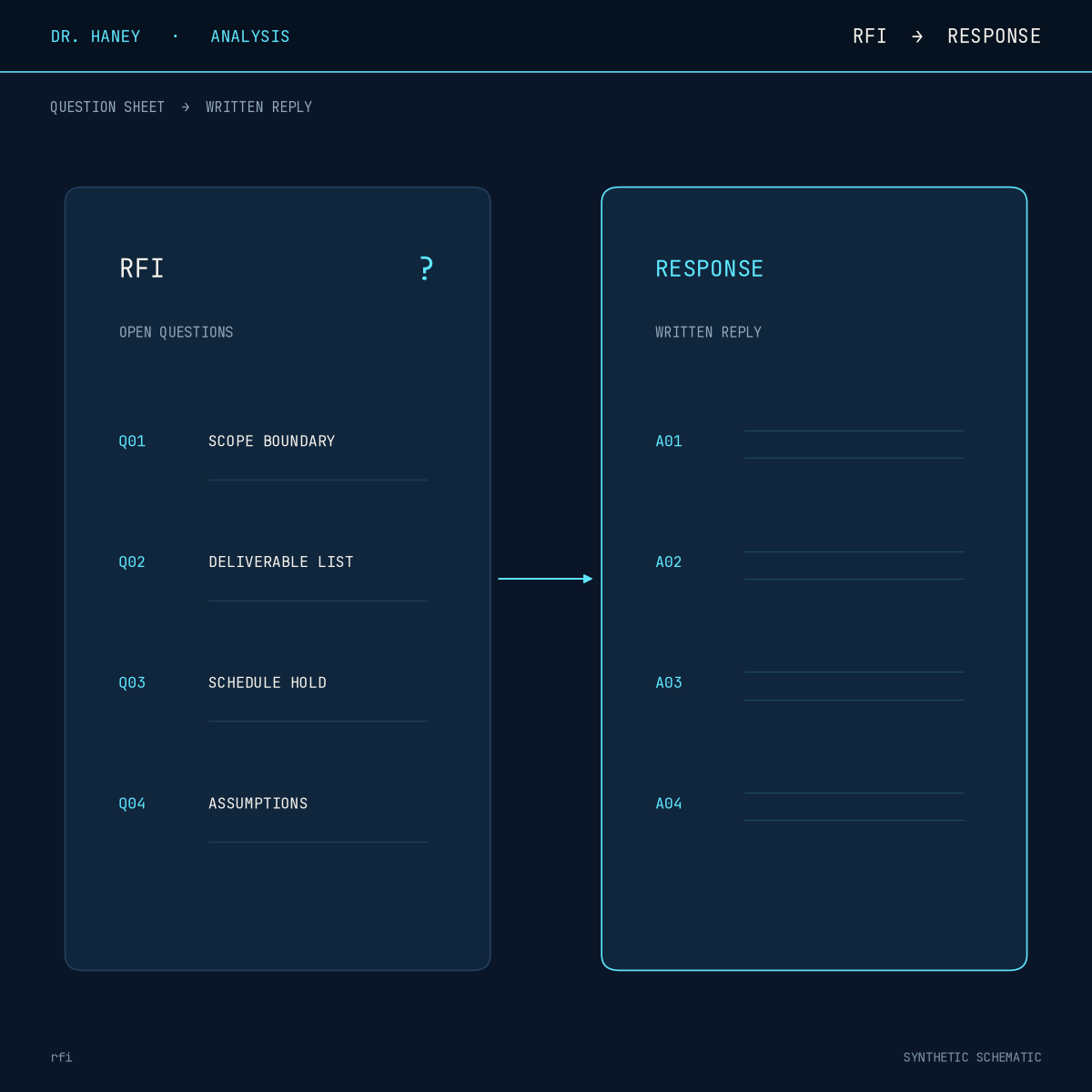
Dr. Haney responds to every Request for Information (RFI). Firm fixed price. Not an estimate.
The response answers the question asked. It is a full written report, and it is limited to the information in that request.
Proposal development
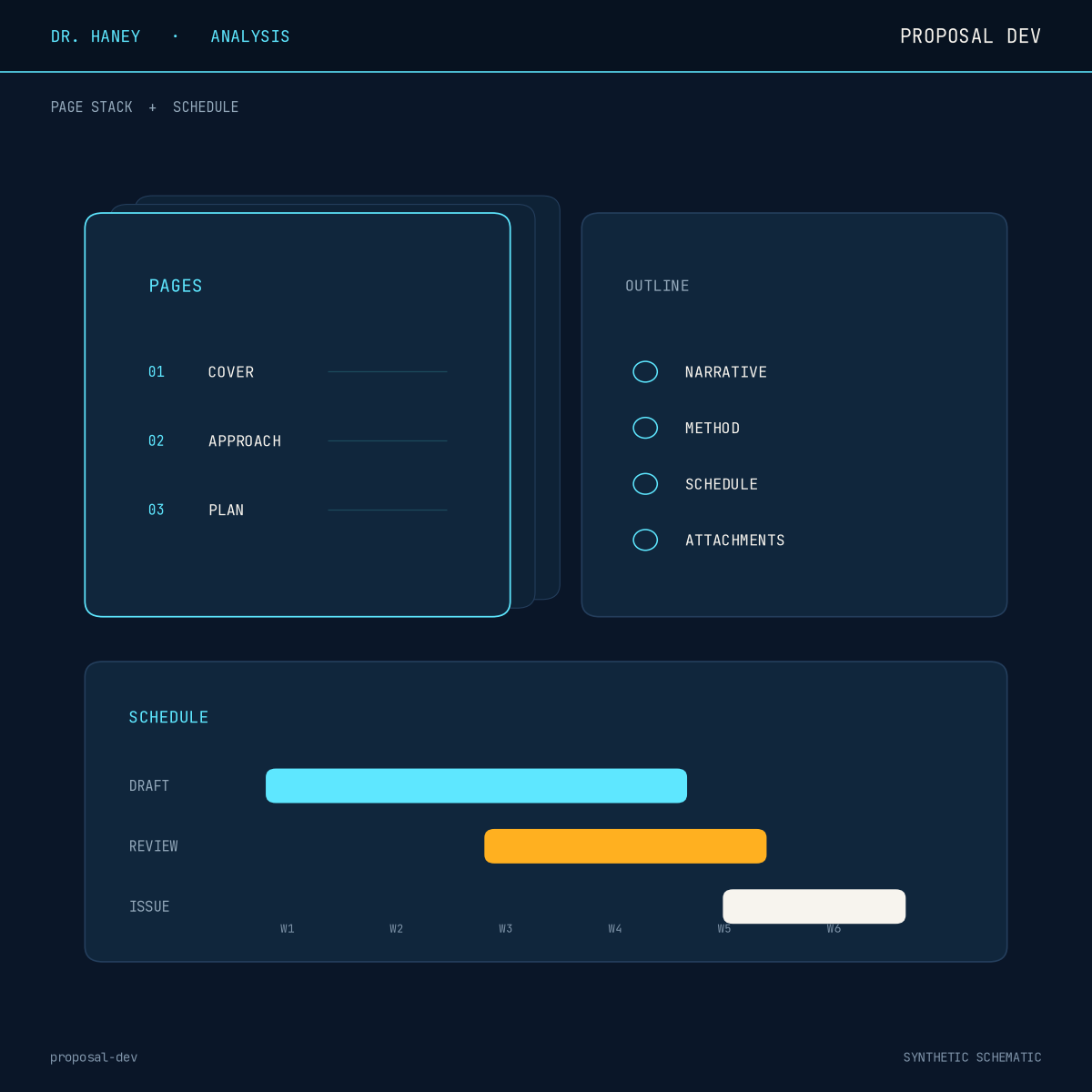
The checkout is the 40-hour minimum only.
The work counted is proposal-development time; hours past 40 stay outside this checkout.
Bid room
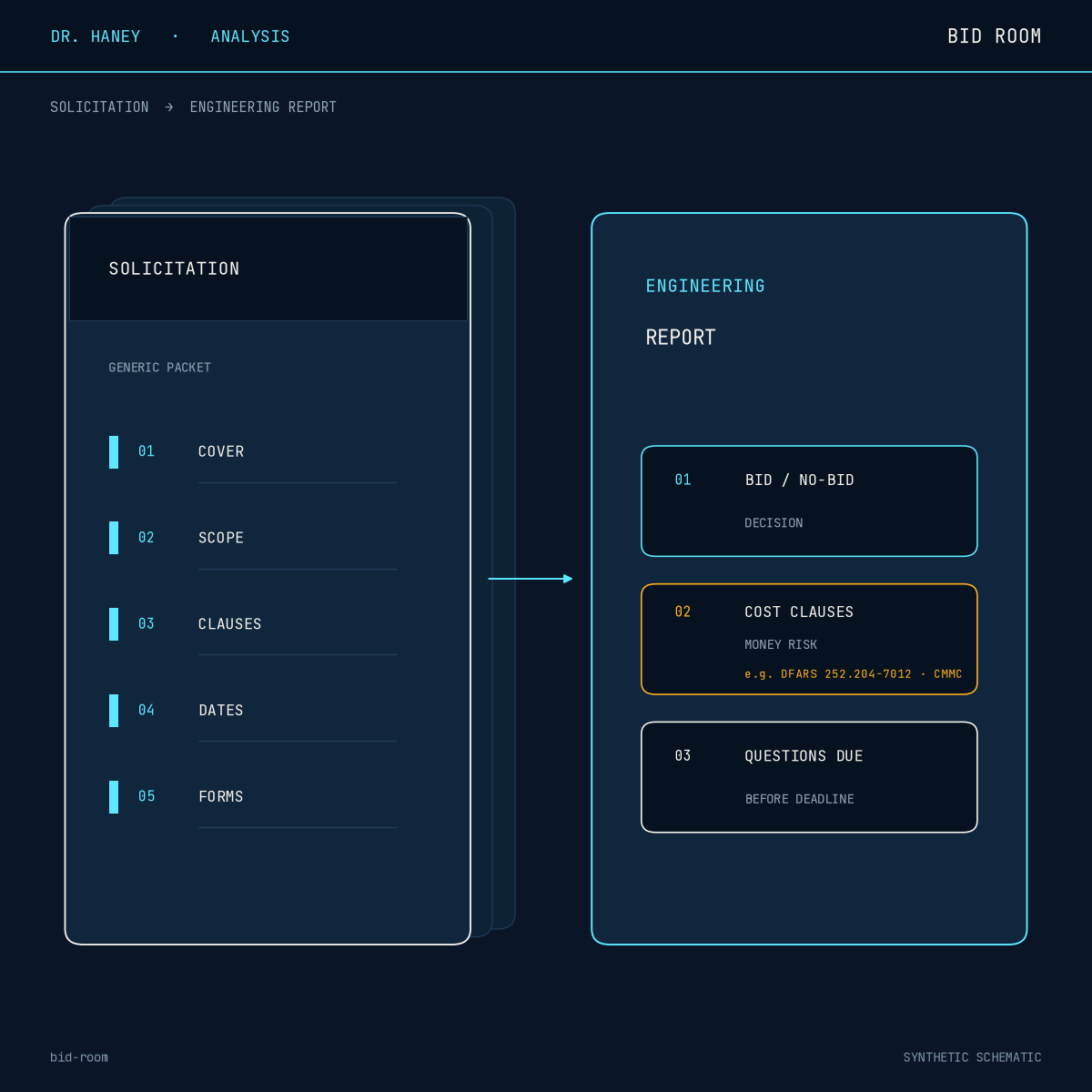
A government solicitation is reviewed in full. The deliverable is a full written report. Firm fixed price.
The report says whether to bid, which clauses cost money, and what to ask before the deadline. It is not a bid, not a proposal, and not a legal opinion.
01 · Image analysis
Each engagement reviews the thermal imagery and supporting data provided. The deliverable is a full written report of the findings and the limits of those materials.
Roof heat
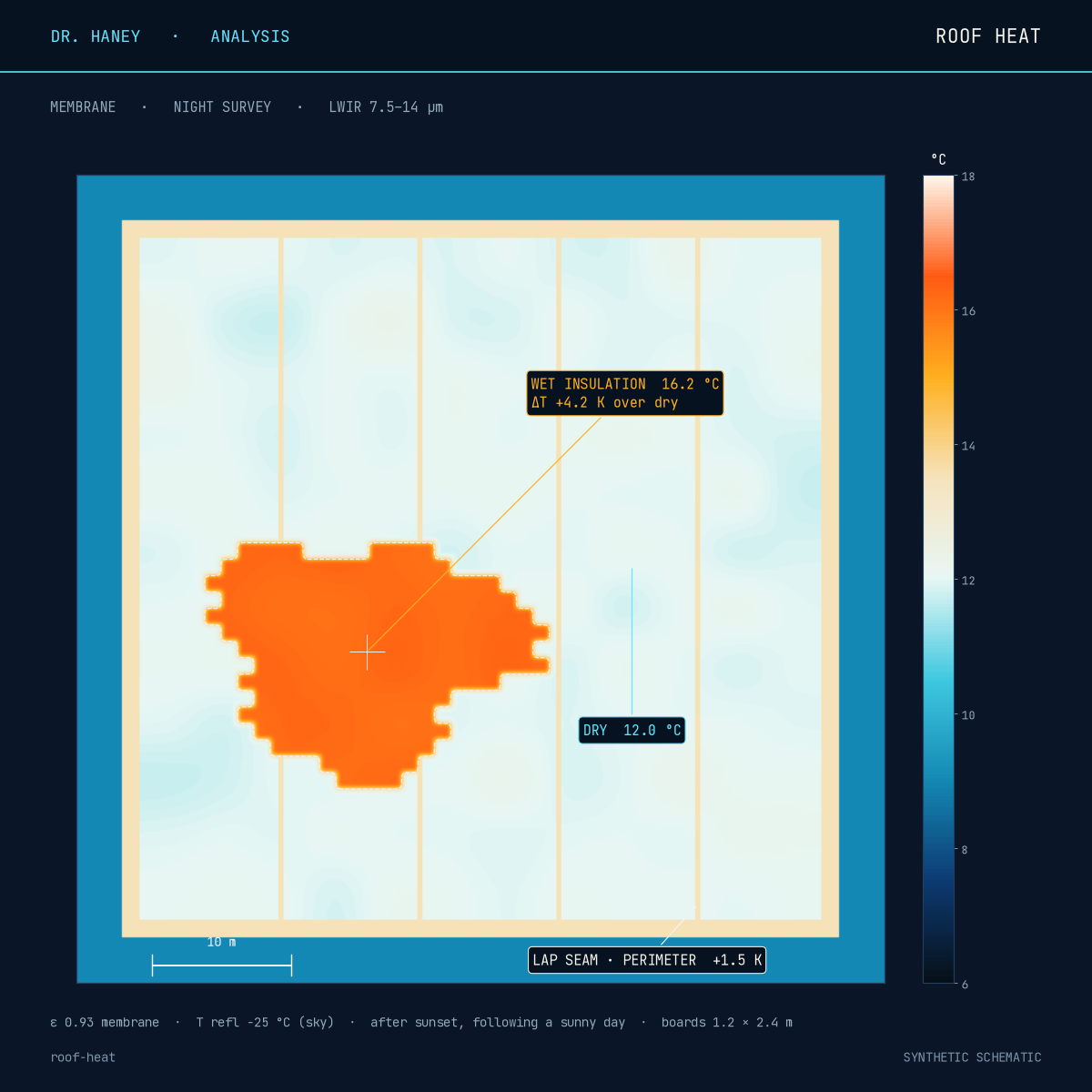
Roof IR: wet insulation, thermal bridges, and anomalous warm or cool patches in the membrane. Thermal bridging is the main confound.
Measured quantity: apparent radiant temperature of the membrane. The report names each anomalous patch, and it cannot separate wet insulation from a reflection or a missing scale.
Solar fault
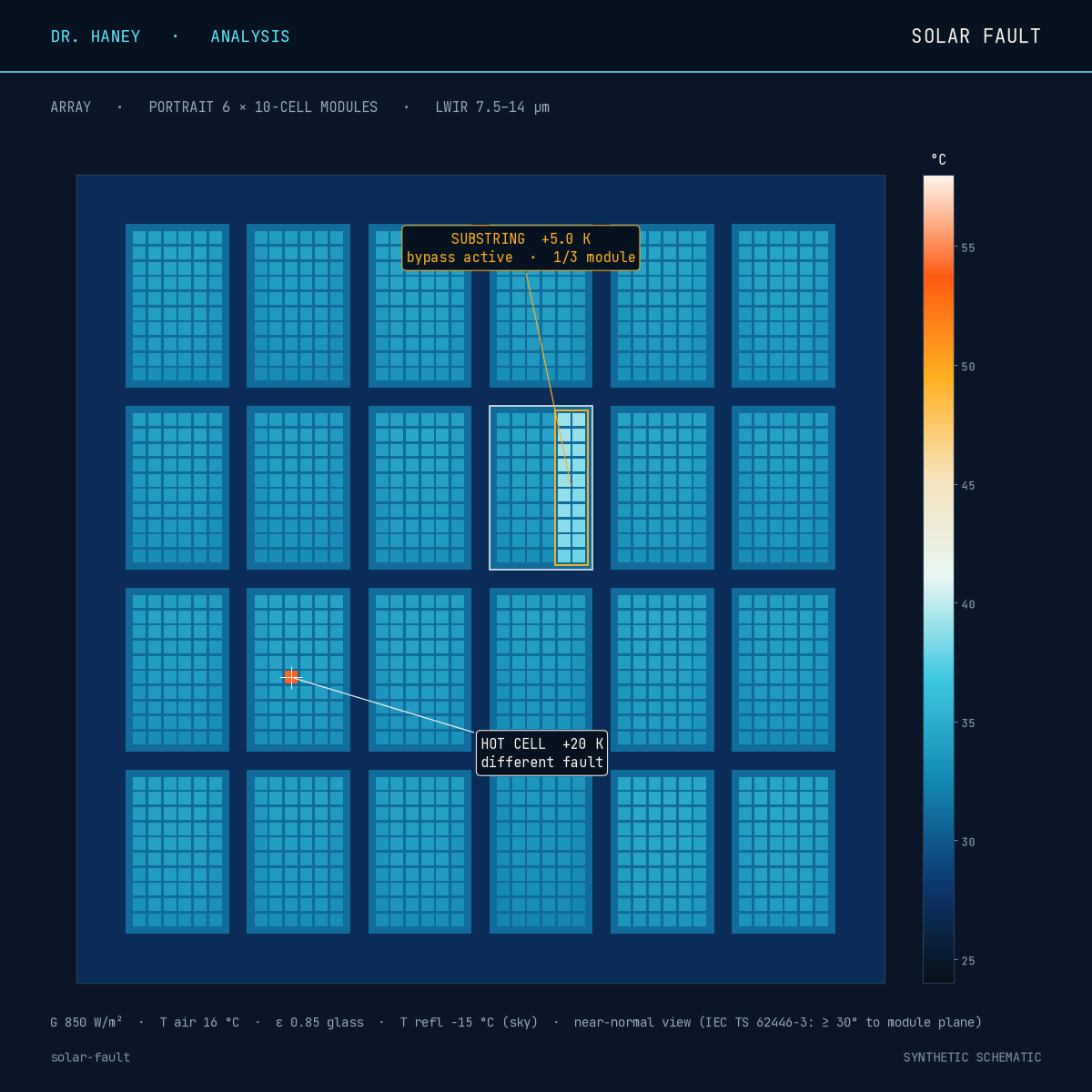
PV module hot spots, bypass-diode and substring signatures, and string mismatch as far as the imagery and supporting data support.
Measured quantity: module apparent temperature. The report counts hot cells, bypass-diode signatures, and string mismatch the materials support, and it cannot prove a fault the materials do not show.
Solar farm
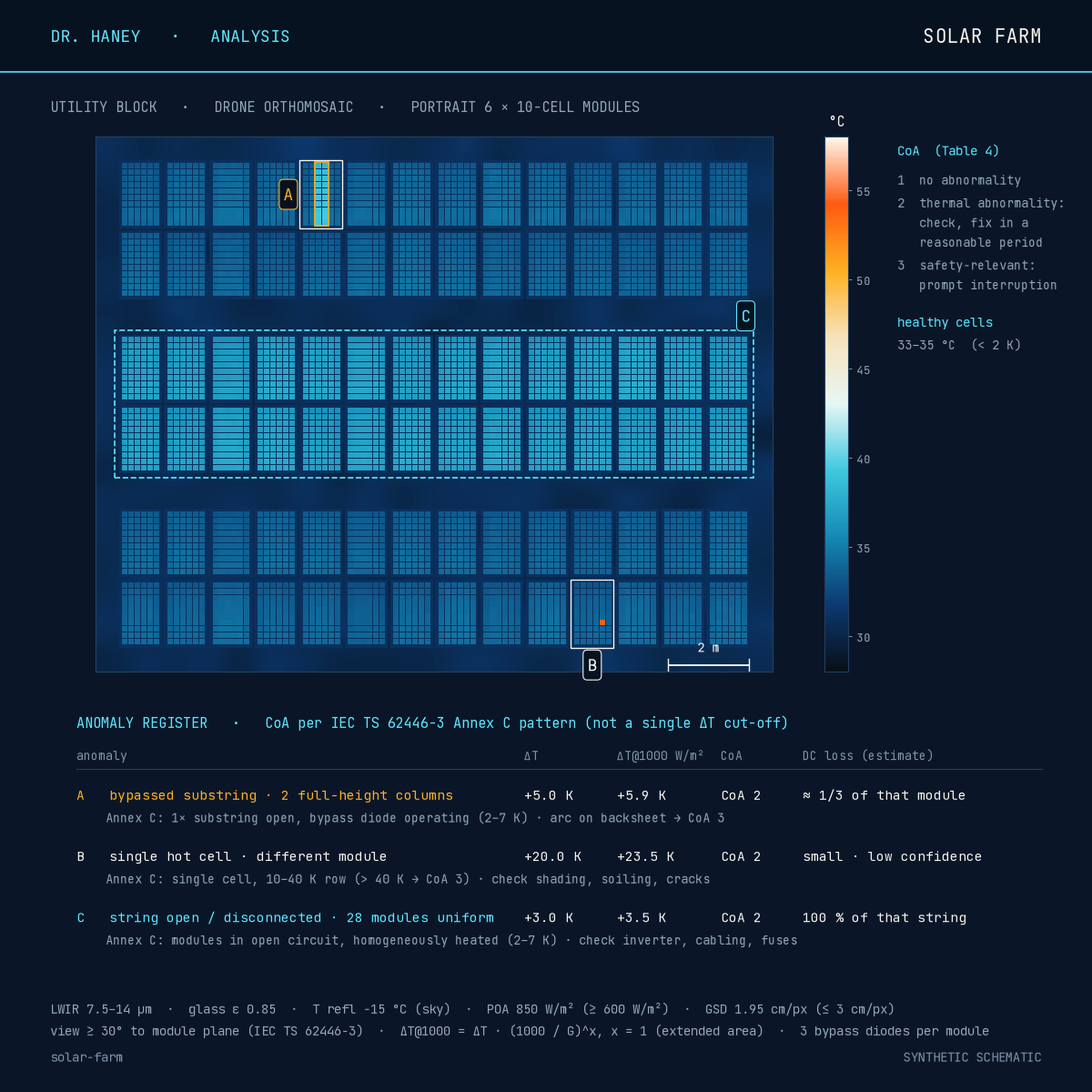
Drone infrared survey of a PV array, analyzed against IEC TS 62446-3:2017. The capture is checked first for irradiance, wind and cloud, viewing angle, and resolution. Not an EL test, not an I-V curve test, and not a warranty determination.
Measured quantity: module apparent temperature and difference against healthy neighbors, at the recorded irradiance. A full written report locates each anomaly, assigns its Class of Abnormality (CoA 1, 2, or 3) as the standard defines it, estimates the DC power lost by anomaly type with the estimation method and its limits stated, and states which parts of the survey met the capture conditions.
Kiln crack
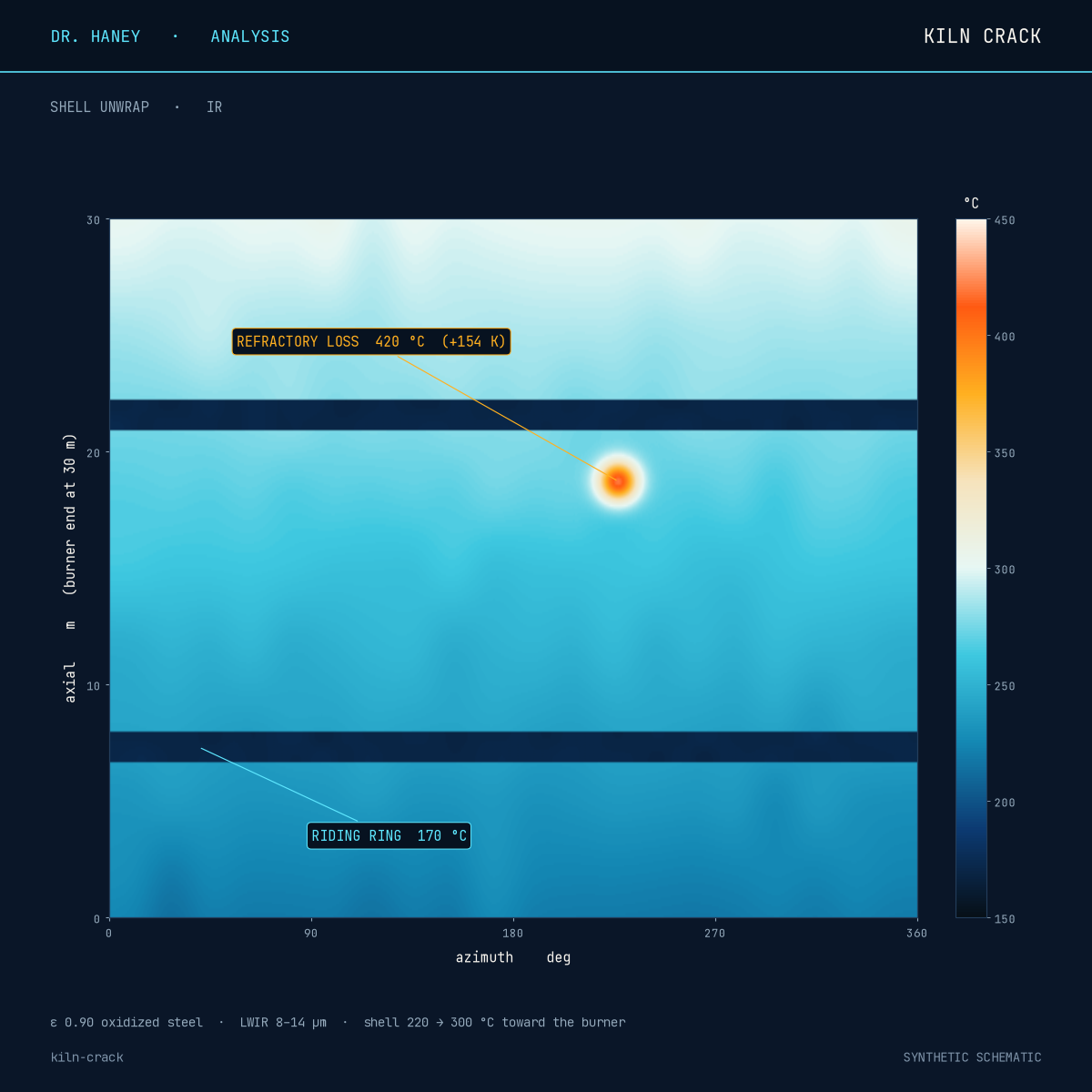
Kiln or furnace shell gradients that can indicate refractory loss, a crack, or a hot spot in the lining. An analysis of the imagery and supporting data, not a refractory inspection.
Measured quantity: shell temperature gradient. The report marks gradients consistent with refractory loss, a crack, or a hot spot.
Furnace shell
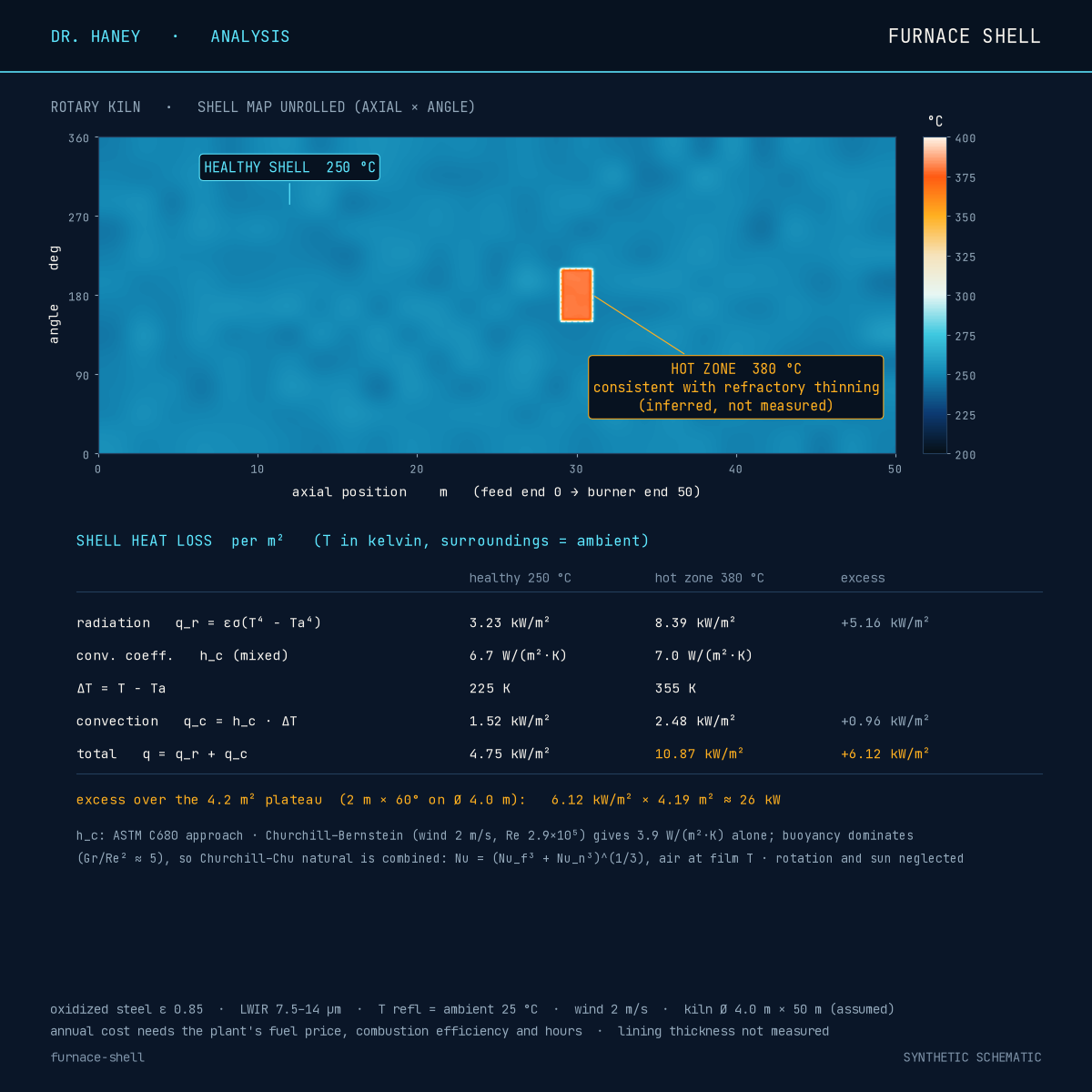
Furnace, kiln, boiler, or steam-line shell imagery analyzed for heat loss and for hot zones consistent with refractory thinning or insulation damage. Not a refractory inspection, not a thickness measurement, and not a structural assessment of the shell.
Measured quantity: estimated shell surface temperature, corrected for emissivity and reflection, at the recorded ambient air and wind. A full written report gives heat loss and annual cost for each zone from the plant’s own fuel price, combustion efficiency, and operating hours, and ranks repairs. Refractory thickness is inferred from a stated model, not measured.
Substation hot
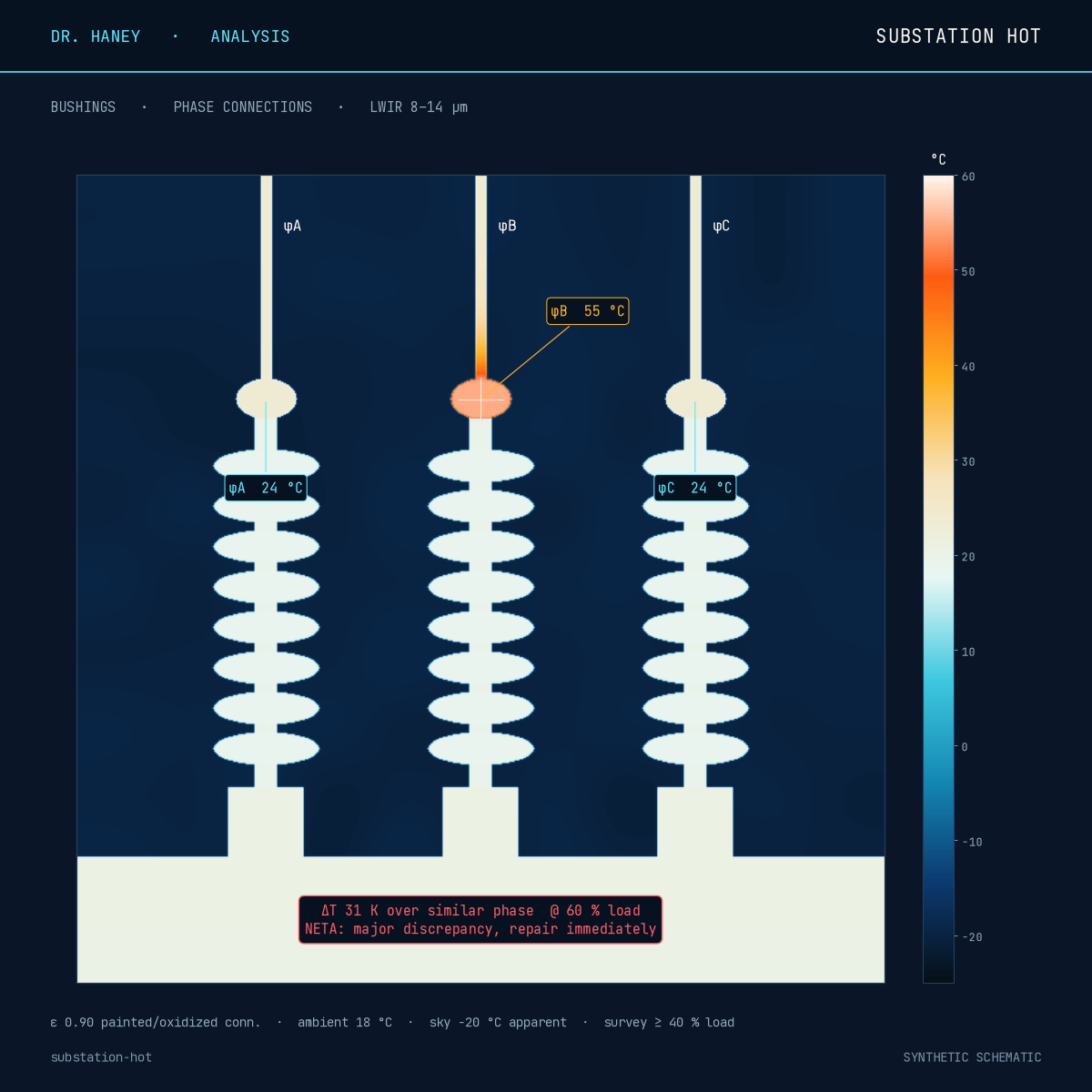
Bushings, connections, and tank or equipment hot spots in the imagery and supporting data provided. Not a substitute for a qualified electrical inspection. The analysis does not include switching.
Measured quantity: apparent temperature of bushings, connections, and tanks. The report lists those hot spots.
Bearing hot
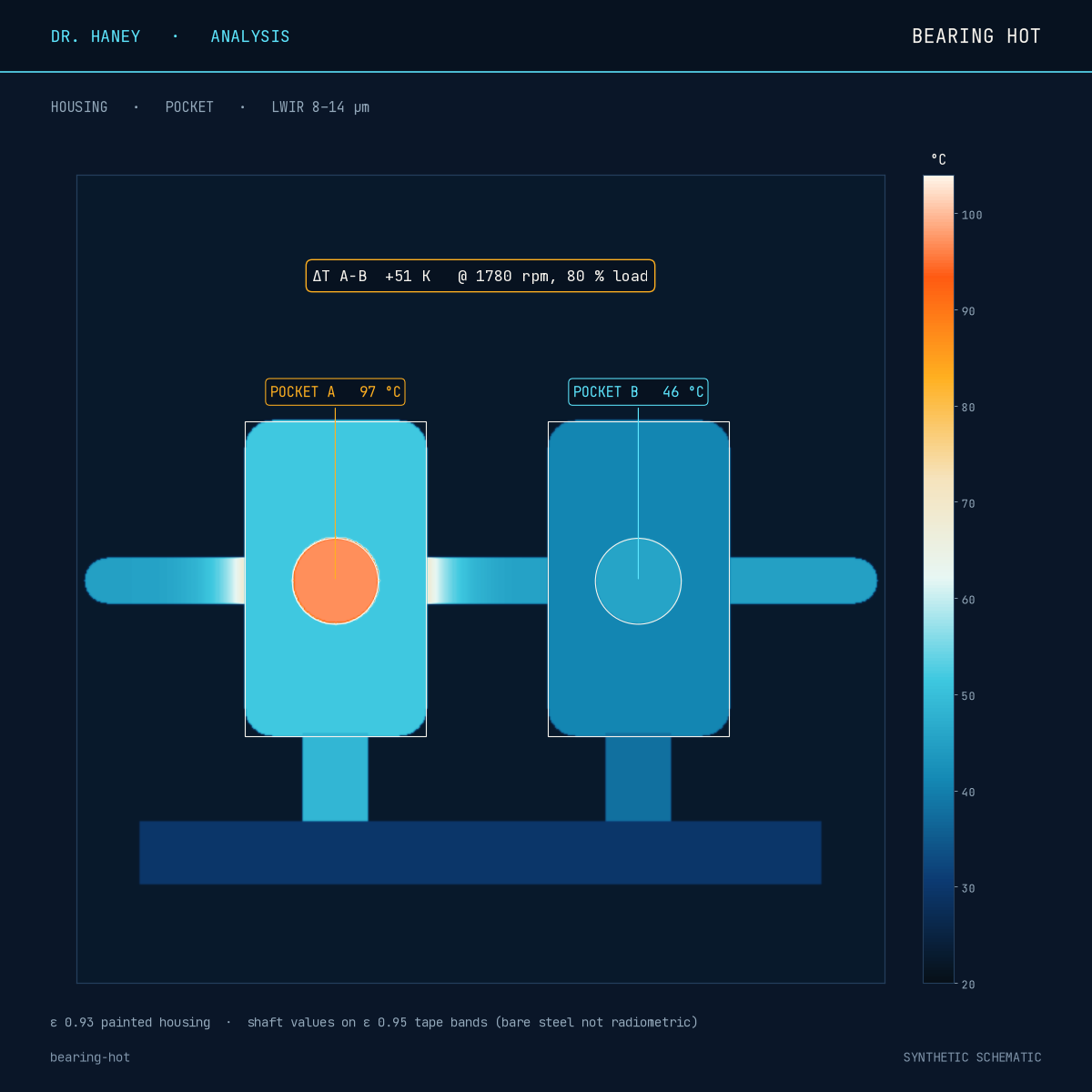
Bearing-housing temperature pattern on rotating equipment versus an obvious neighbor or the rest of the housing, from the imagery and supporting data provided.
Measured quantity: housing apparent temperature versus a neighbor or the rest of the housing. The report states that difference, and it cannot name a defect the materials do not show.
Steam trap
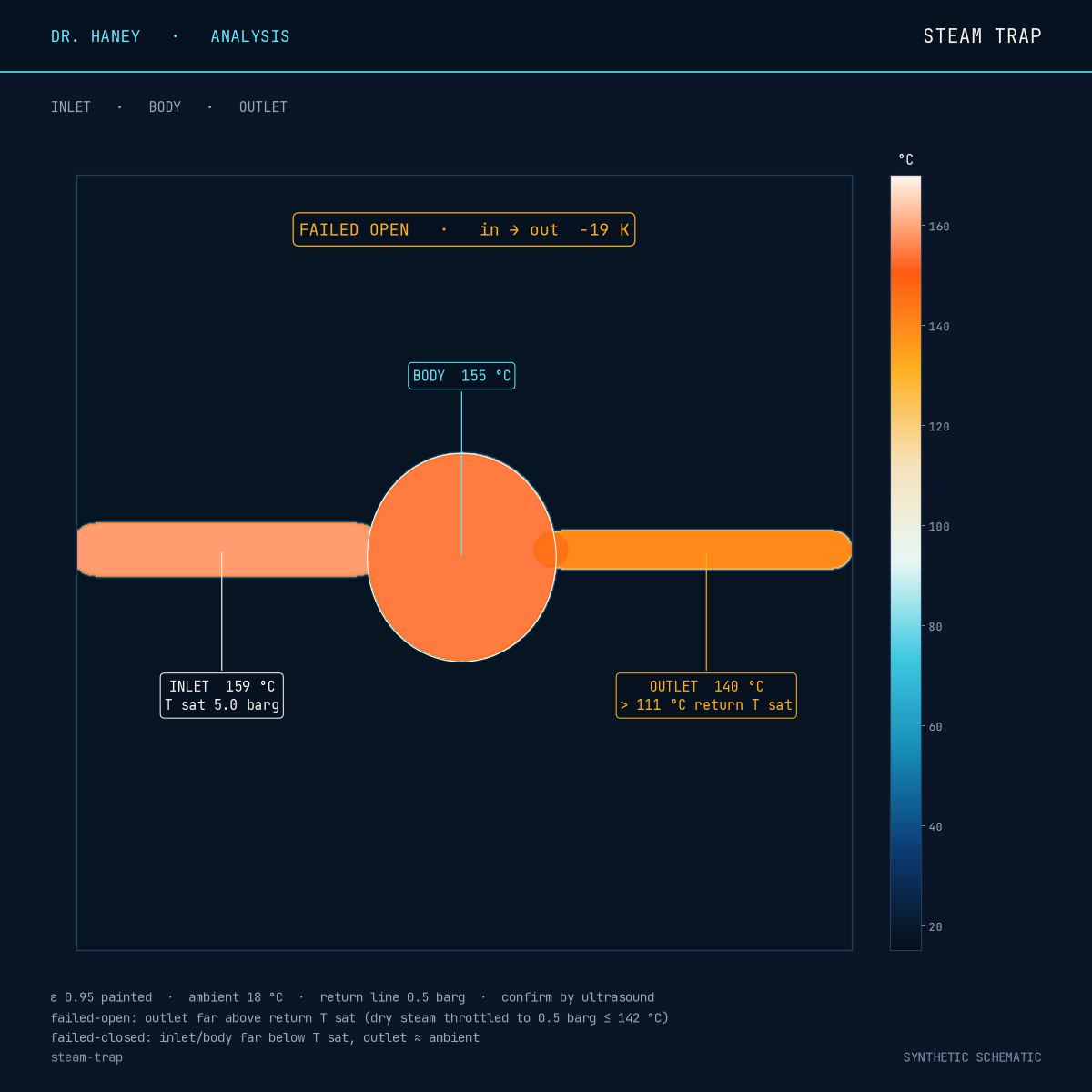
Trap body and discharge pattern consistent with failed-open, failed-closed, or cycling, from the imagery and supporting data provided.
Measured quantity: trap-body and discharge apparent temperature. The report says whether the pattern fits failed-open, failed-closed, or cycling.
Panel hot
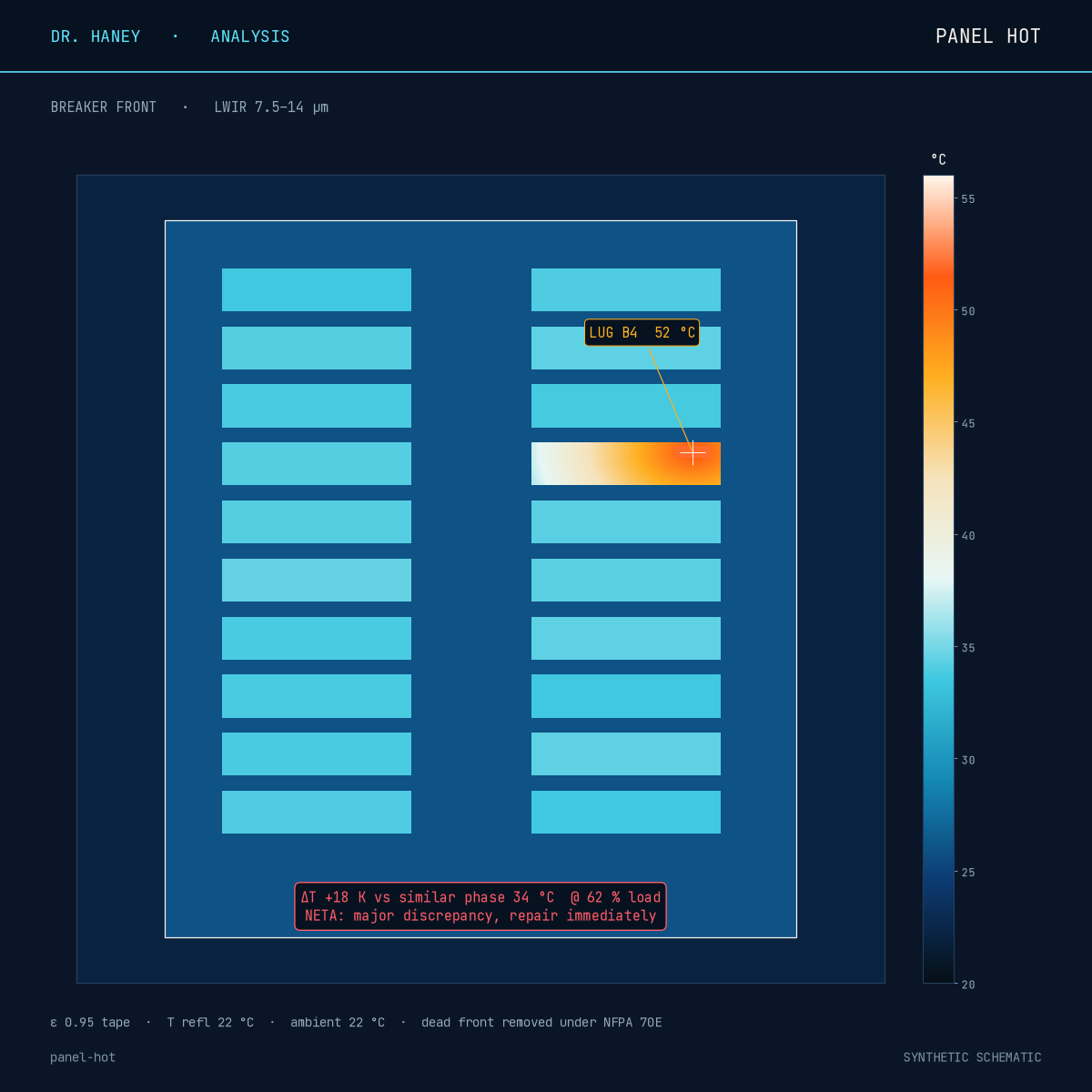
Panel, breaker, or connection hot spots in the electrical-panel imagery and supporting data provided. Not an arc-flash study and not a code inspection.
Measured quantity: apparent temperature of the panel, breaker, or connection. The report lists those hot spots.
Switchgear risk
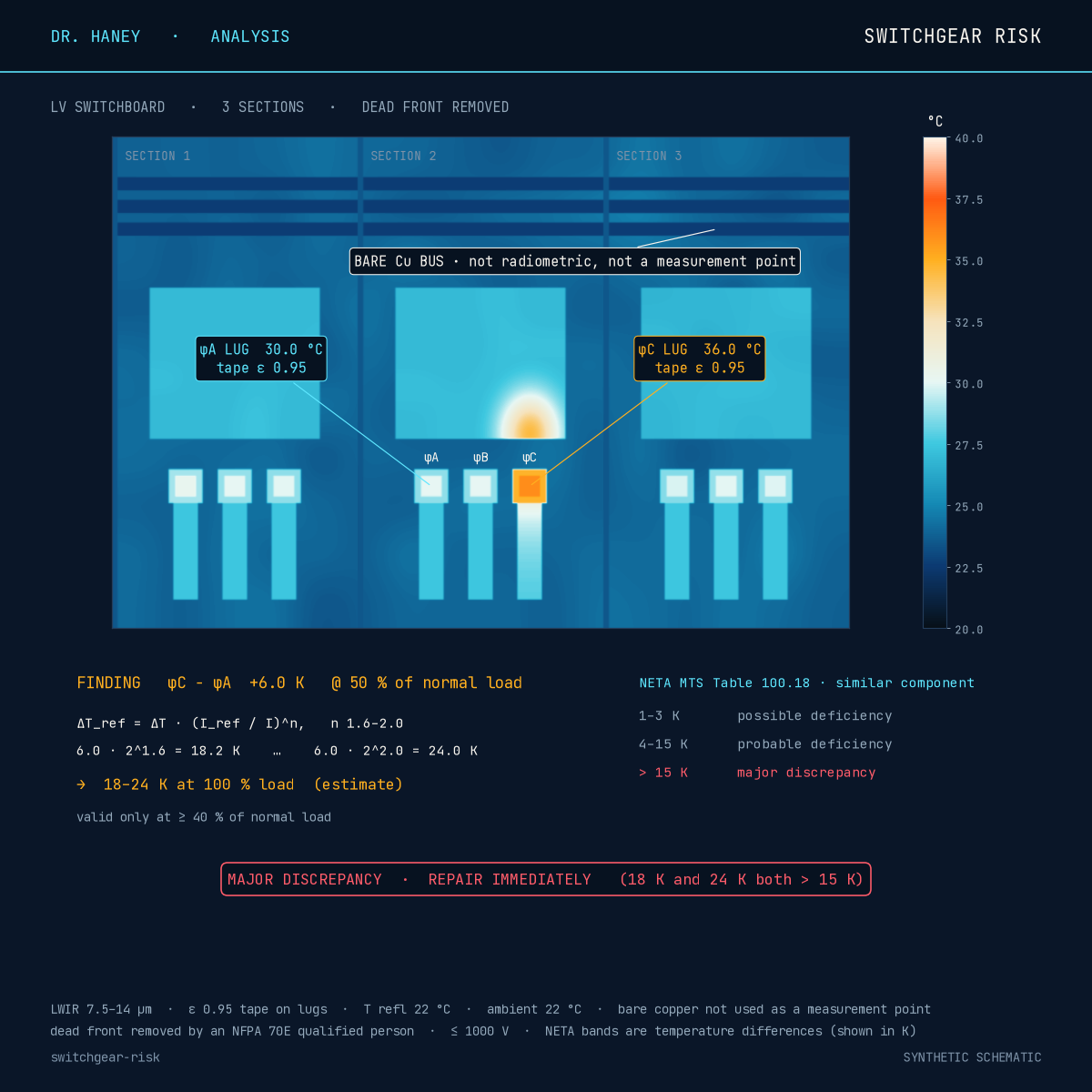
Infrared scans of panels, switchboards, and switchgear under load. Each hot connection is measured against a like component and against ambient air, then ranked with the ANSI/NETA thermographic survey criteria. Not an arc-flash study, not a code inspection, and not a substitute for repair by a qualified electrical worker.
Measured quantity: apparent temperature rise (ΔT) of each connection, breaker, fuse, or conductor against a reference, at the recorded load. A full written report ranks each hot spot, gives the load-normalized ΔT as an estimate with its range for circuits at 40% or more of rated load, and lists repairs in priority order.
Data center cooling
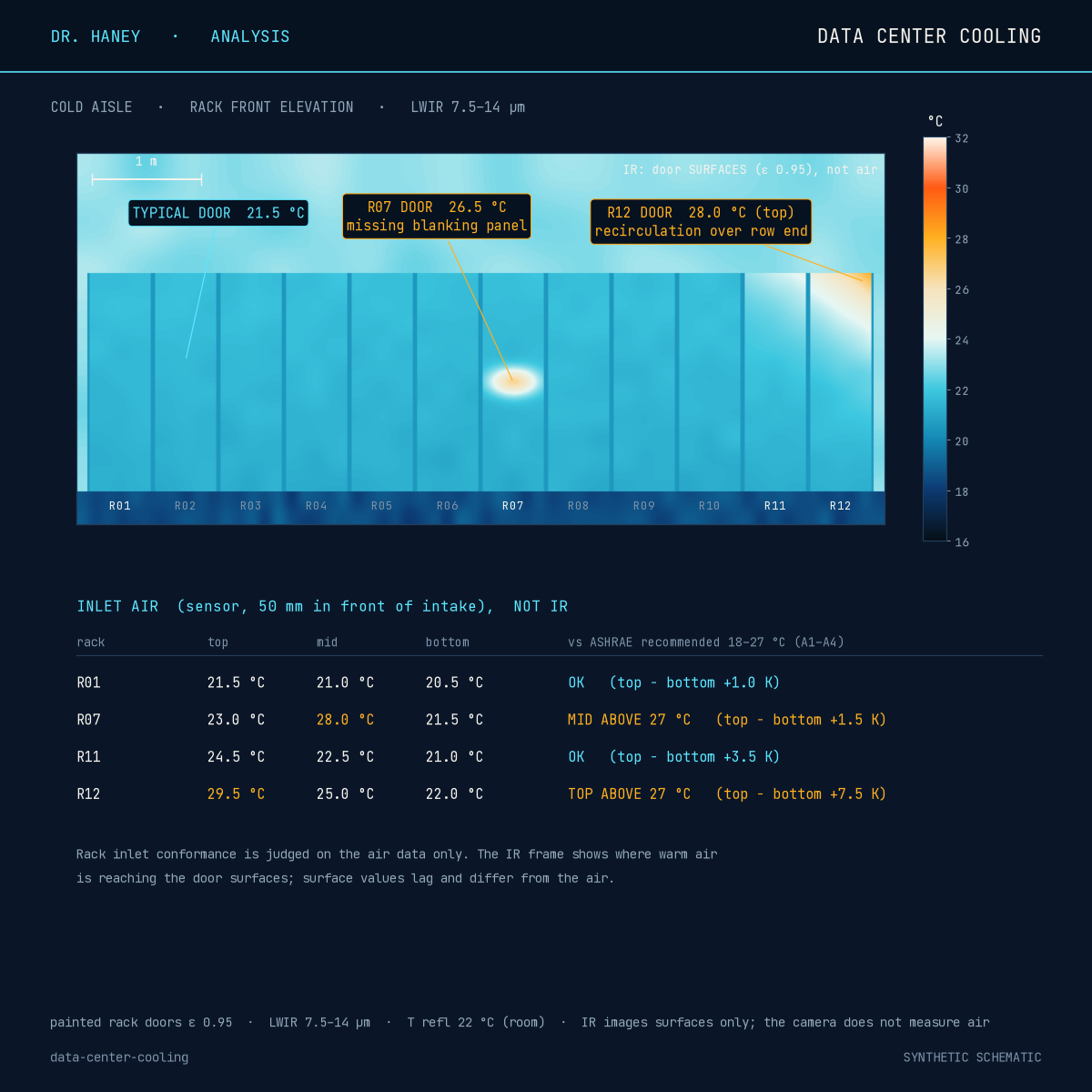
Infrared images of racks, aisles, and cooling units, analyzed with the room’s inlet air temperature data: hot-air recirculation, cold-air bypass, and racks above the ASHRAE TC 9.9 recommended inlet range. Not a CFD study, not a commissioning test, and not a guarantee of savings.
Measured quantity: apparent surface temperature of rack faces, blanking panels, doors, tiles, and cooling units, paired with measured inlet air temperature. A full written report maps recirculation and bypass, lists the racks outside the recommended inlet range on the air data, and gives a cooling-savings estimate with every assumption stated.
Cold room
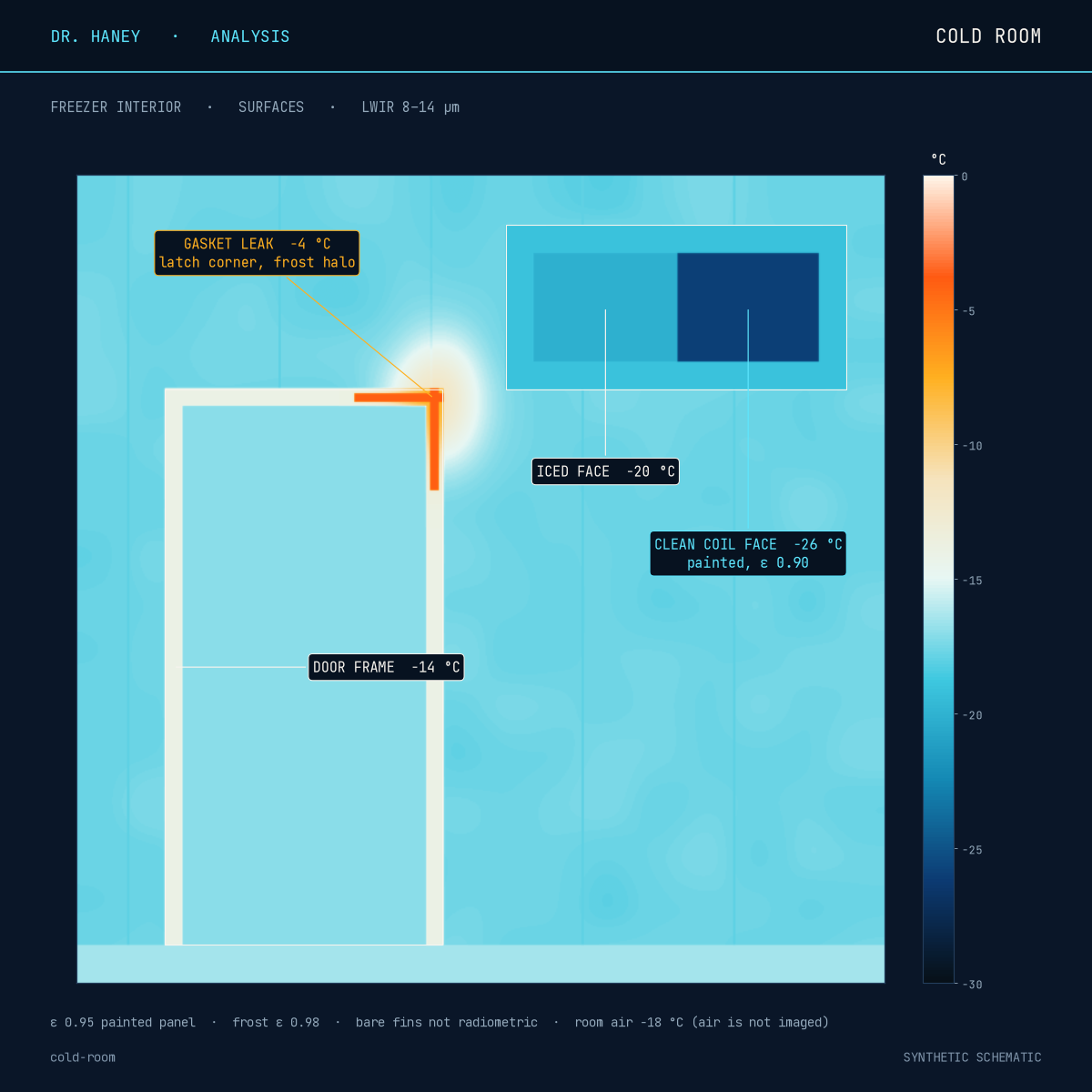
Cold-room envelope, door-seal, and evaporator patterns: air leaks, icing, warm intrusion.
Measured quantity: envelope, door-seal, and evaporator apparent temperature. The report marks air leaks, icing, or warm intrusion, and it cannot size a refrigeration load.
Pipe leak
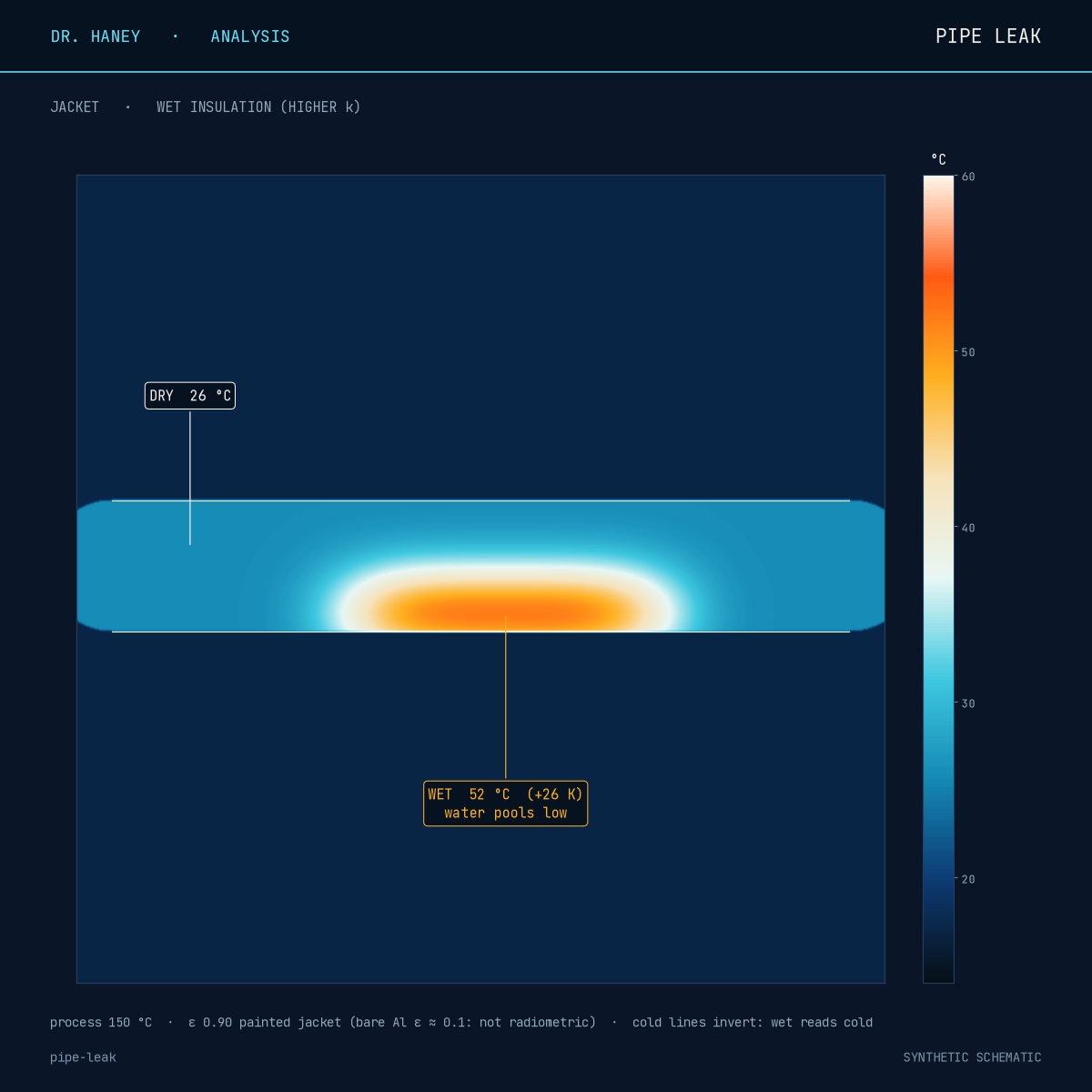
Insulation and pipe temperature anomalies consistent with a wet section or a leak. Not a pressure test.
Measured quantity: insulation and pipe apparent temperature. The report marks anomalies consistent with a wet section or a leak, and it is not a pressure test.
Flare stack
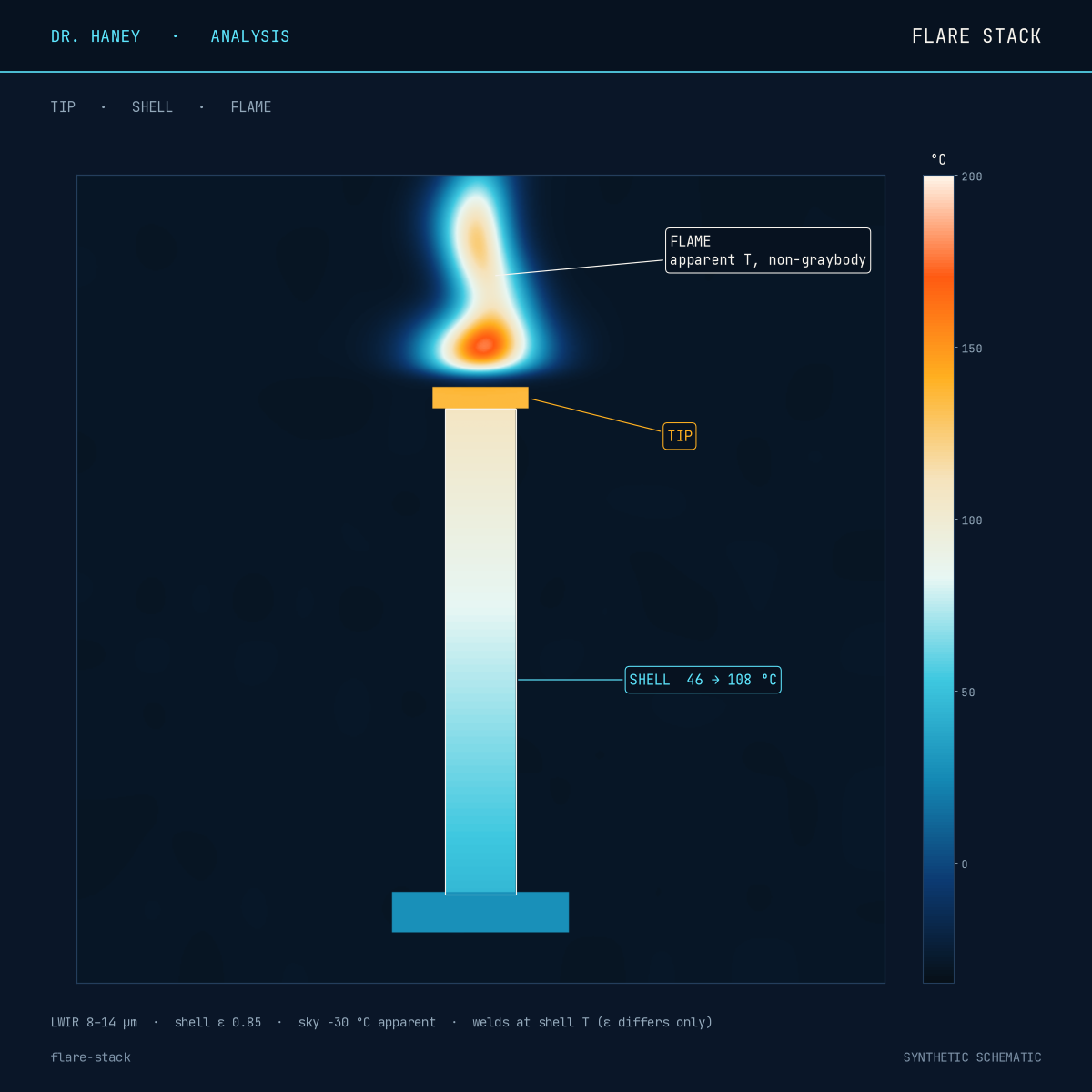
Flare tip and stack-shell thermal pattern from the imagery and supporting data provided. Not an emissions test and not a stack inspection.
Measured quantity: flare-tip and stack-shell apparent temperature. The report describes that pattern. It is not an emissions test or a stack inspection.
02 · Reports
Each engagement delivers a full written report on the imagery and supporting data provided.
Range truth
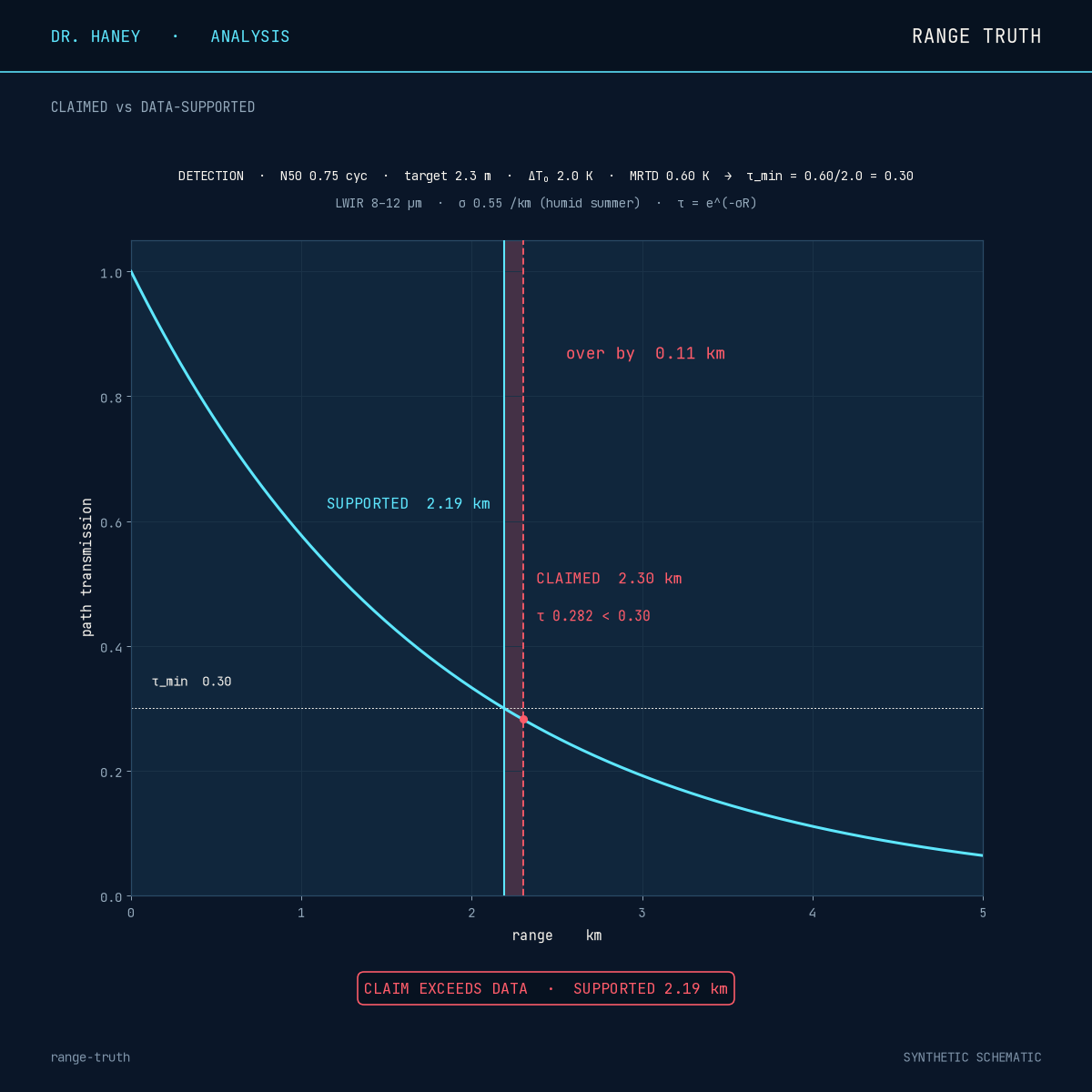
A claimed infrared detection, recognition, or identification range. Send the claimed range and the criterion it uses, the target size and contrast, the atmospheric assumptions, and the radiometric or trial data that is supposed to show it.
The report says yes or no: whether that claimed range holds in the supplied data, and the limit of what the data can show. Not a field trial. This is not Range lie.
Measured quantity: the claimed detection, recognition, or identification range against the supplied target size, contrast, atmosphere, and data. The report gives one yes or no on whether that range holds, and it is limited to the supplied data.
Coating truth
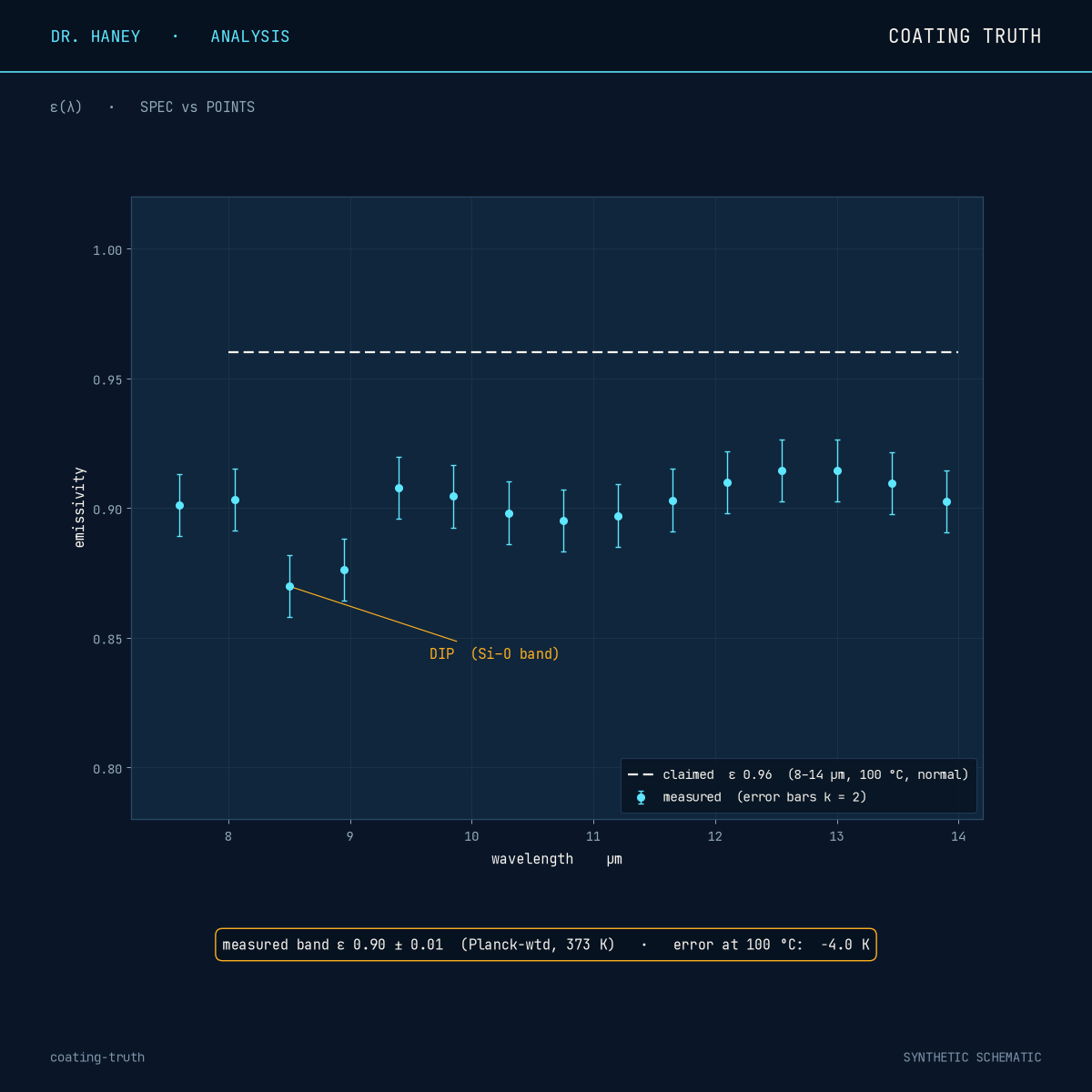
A claimed coating emissivity or thermal-coating spec. Send the claimed emissivity or coating spec (band and temperature), the substrate, the target’s kinetic temperature or a reference of known emissivity, and the radiometric readings or images against that reference.
The report says whether that coating spec holds in the supplied data, and what the data cannot show. Not a materials certification. The curve-only price is $46,800. The coupon-on-spectrometer option is $56,880, higher because it adds a real spectrometer measurement.
Measured quantity: claimed emissivity or coating spec against the supplied radiometry. The report says whether that spec holds in the supplied data, and it cannot certify a material.
Camera match
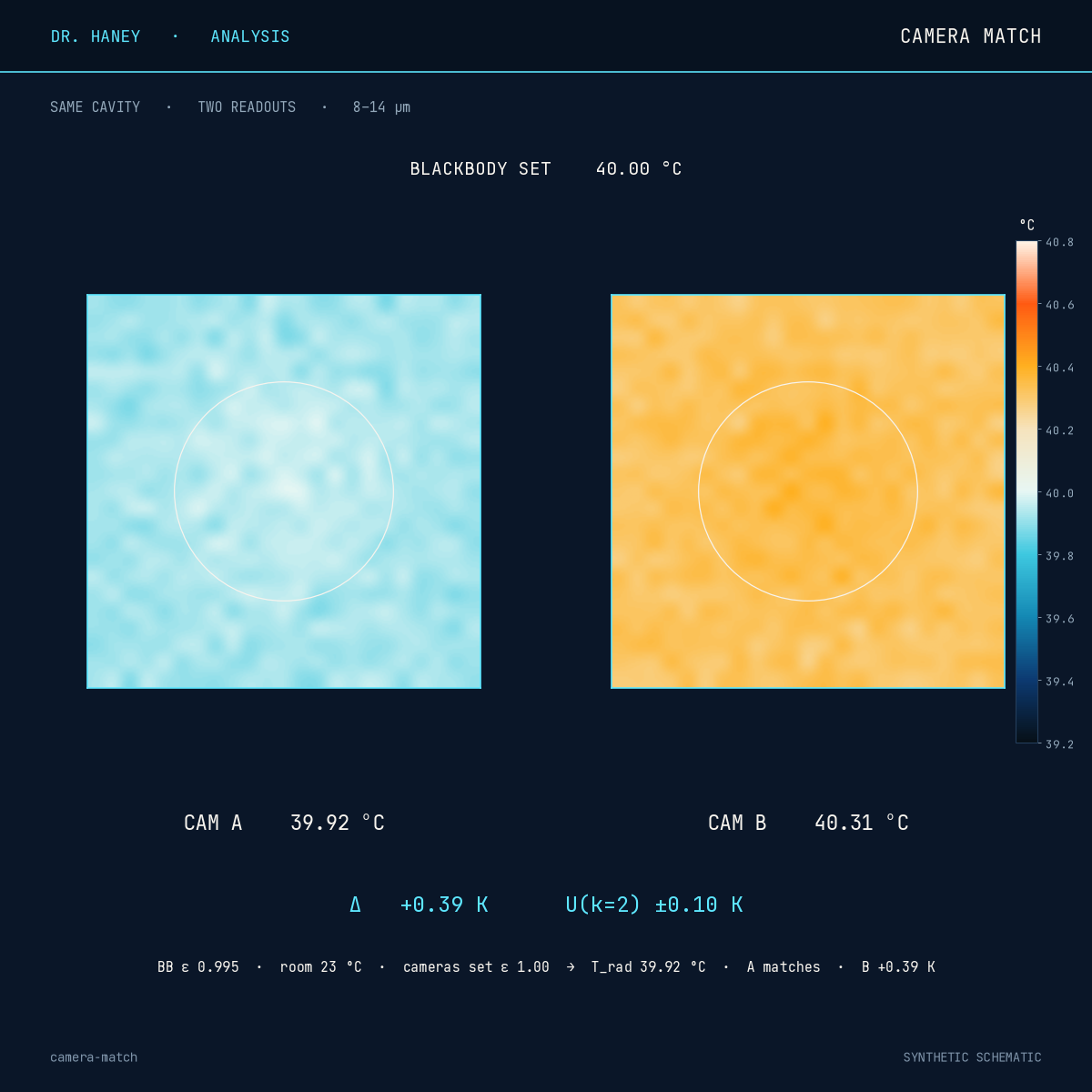
Two infrared cameras disagree on the same target. Send both cameras’ radiometric outputs of that target, the time alignment, the band, the distance, a description of the target, and any blackbody or reference reading taken with them.
The report names which camera is radiometrically right, the size of the disagreement, and the reason: calibration, emissivity assumption, reflection, band, or something the data cannot separate. The report covers the pair of cameras and the supporting data provided. This price covers the two-camera comparison only. Not a camera repair and not a lab accreditation.
Measured quantity: the radiometric disagreement of two cameras on the same target. The report names which camera is right, the size of the disagreement, and the reason the data can separate, and it covers the two-camera comparison only.
Turnaround
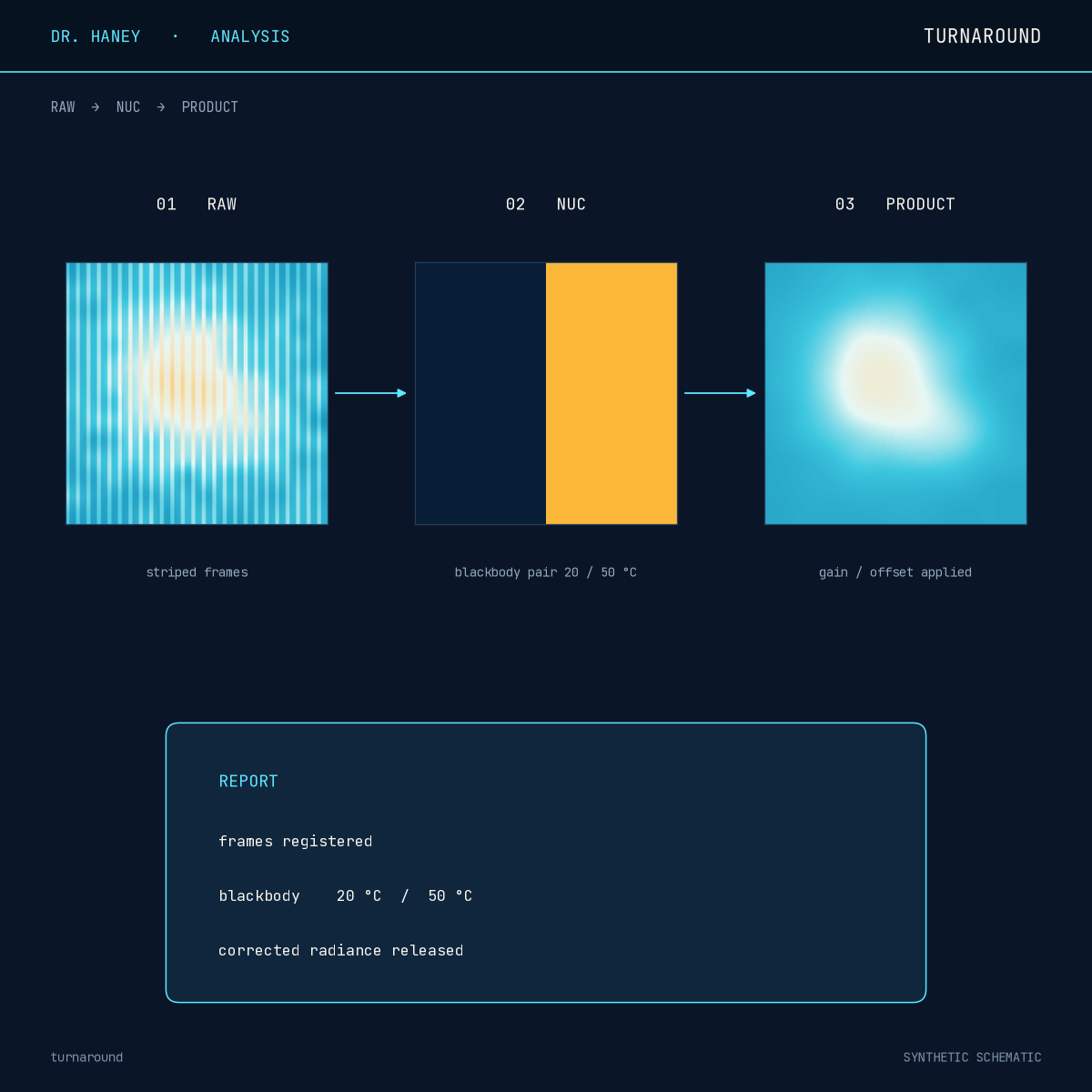
Raw infrared collection in. A radiometrically corrected data product, returned in days, not the same hour. Send the raw collection, the camera model and band if you have them, calibration or blackbody frames if you have them, and what the collection was aimed at.
The deliverable is that corrected data product plus a full written report of what was applied and what the collection could not support. Not a camera certification.
Measured quantity: the radiometric correction applied to the raw collection. The report states what was applied, and the corrected product cannot add calibration the collection did not contain.
Fusion check
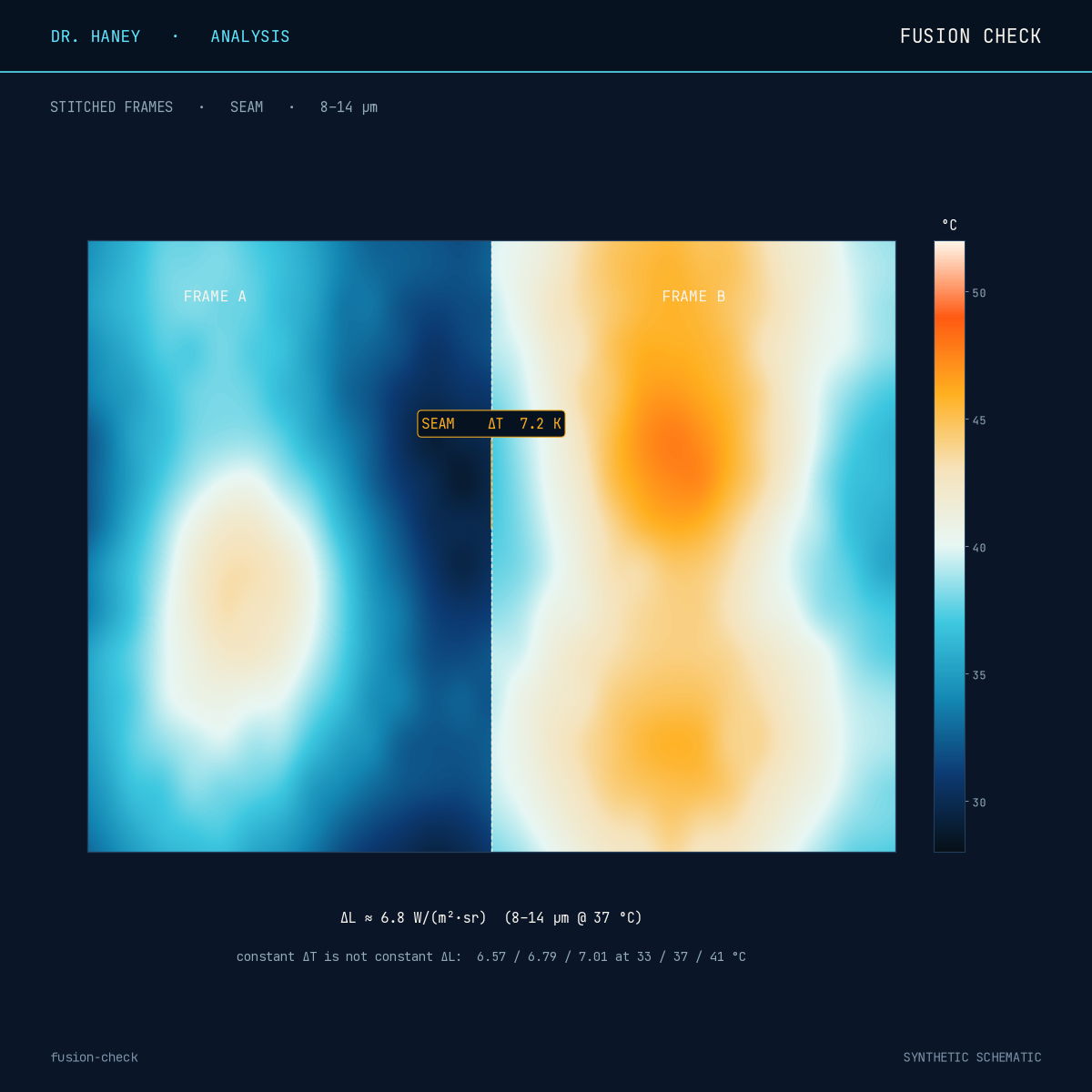
Several infrared cameras stitched into one picture. Send the stitched picture, the source frames from each camera, the overlap regions, the band, and any radiometric calibration applied before the stitch.
The report is a yes or no on whether the seams are radiometrically honest, plus where a seam invents or drops radiance. Not a new stitch job.
Measured quantity: seam radiometry where the cameras overlap. The report gives one yes or no that the seams are radiometrically honest, plus where a seam invents or drops radiance, and it is not a new stitch.
Model fight
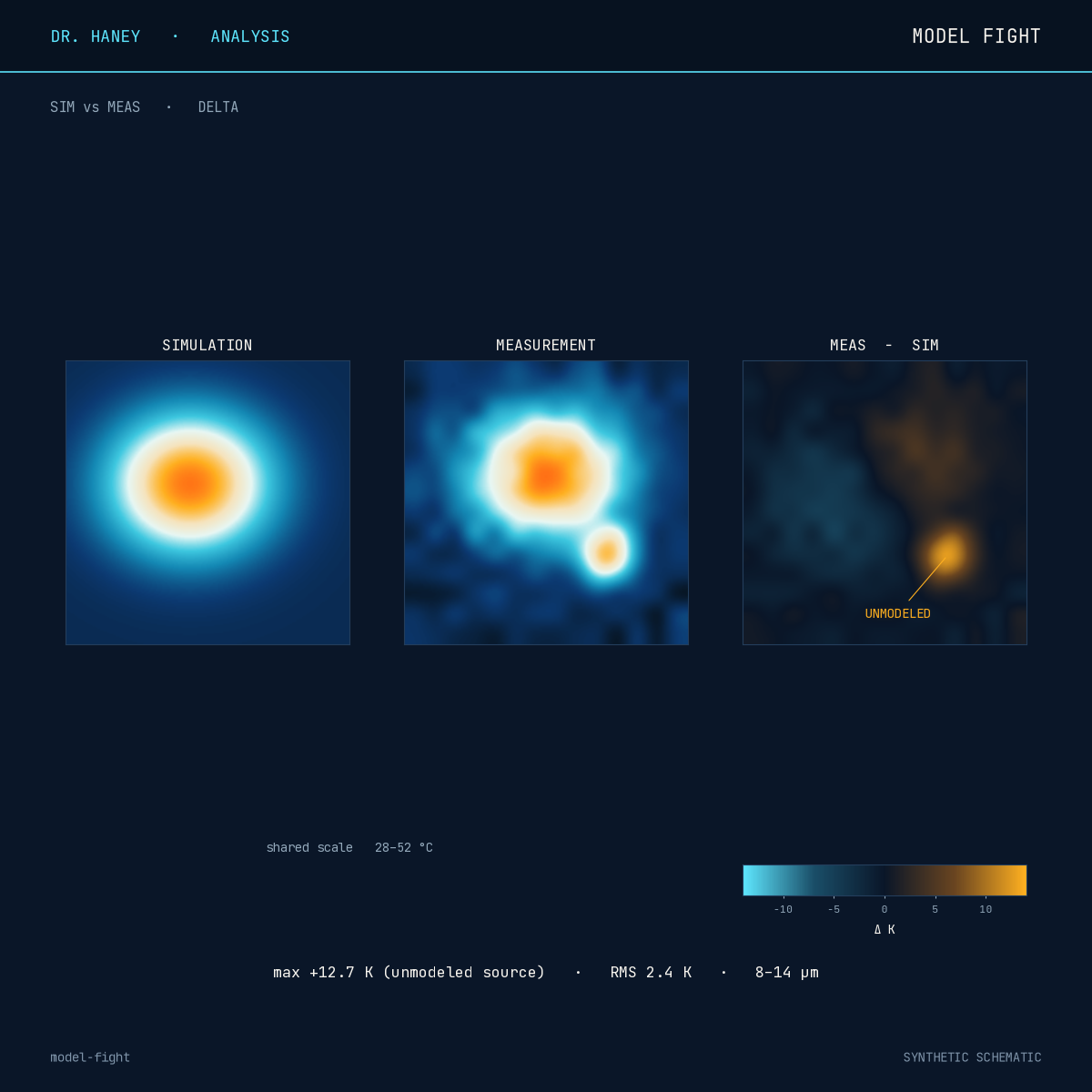
A simulation and a measurement disagree. Send the simulation output, the measurement, the shared inputs, the band or quantity both claim to report, and a short statement of where they disagree.
The report names which to trust, the size of the gap, and what broke: the model, the measurement, or an input neither side stated. The deliverable is a full written report on that disagreement. Not a new simulation and not a new measurement campaign.
Measured quantity: the gap between the simulation output and the measurement on the shared inputs. The report names which to trust, the size of the gap, and what broke, and it is not a new simulation or a new measurement.
Satellite check
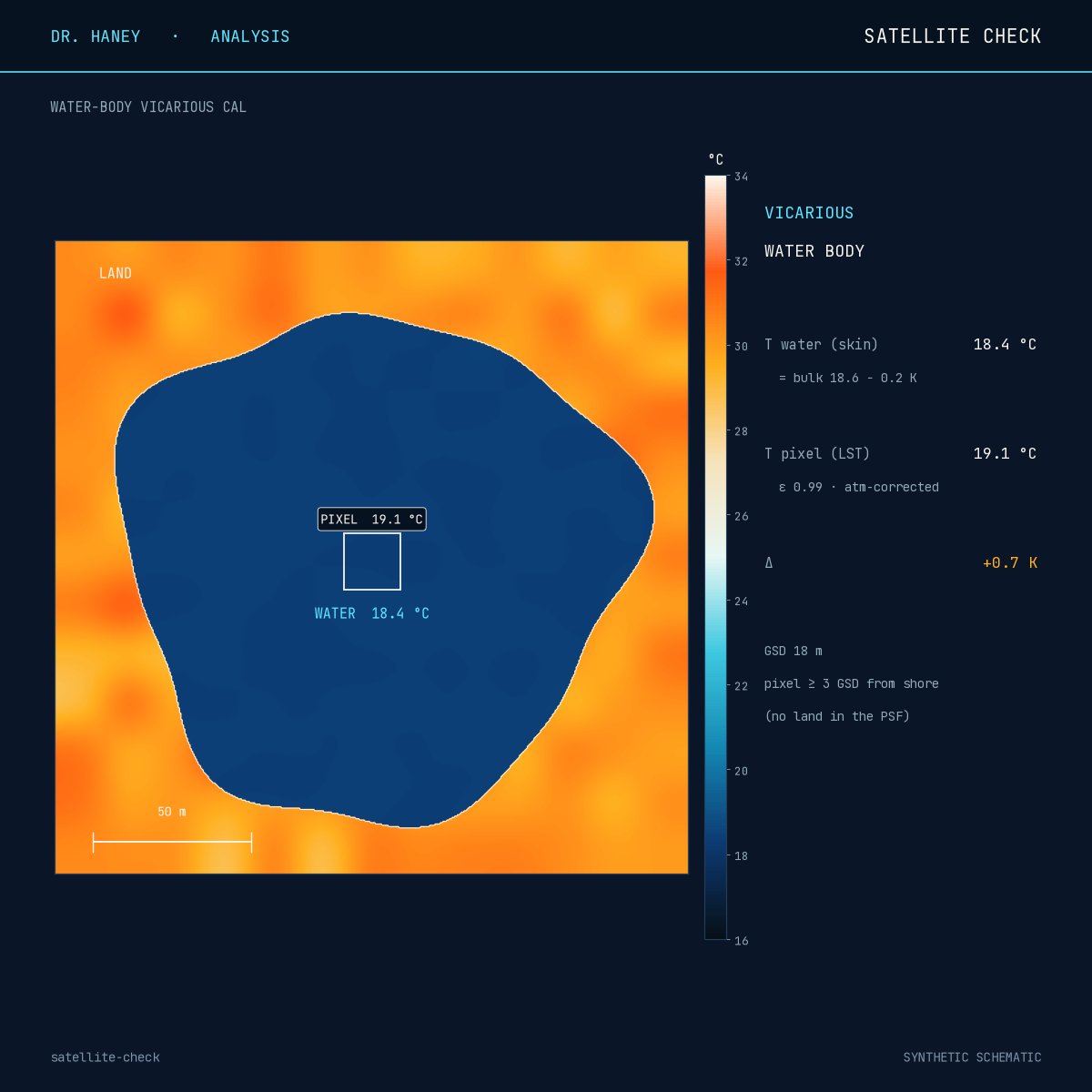
Water-body vicarious calibration. You compare a satellite thermal pixel to a water body of known temperature. Send the pass time, the pixel or crop that should contain the water, the known temperature and how it was measured, the pixel footprint, and the atmospheric conditions at pass time — the atmosphere is the dominant error source.
The report is a yes or no on whether that pixel matched, and the temperature difference. A radiometer quote is still extra and is not included. Not satellite tasking and not a hardware sale.
Measured quantity: the satellite thermal pixel against the known water-body temperature. The report gives one yes or no that the pixel matched and the temperature difference, and a radiometer remains extra.
Heat court
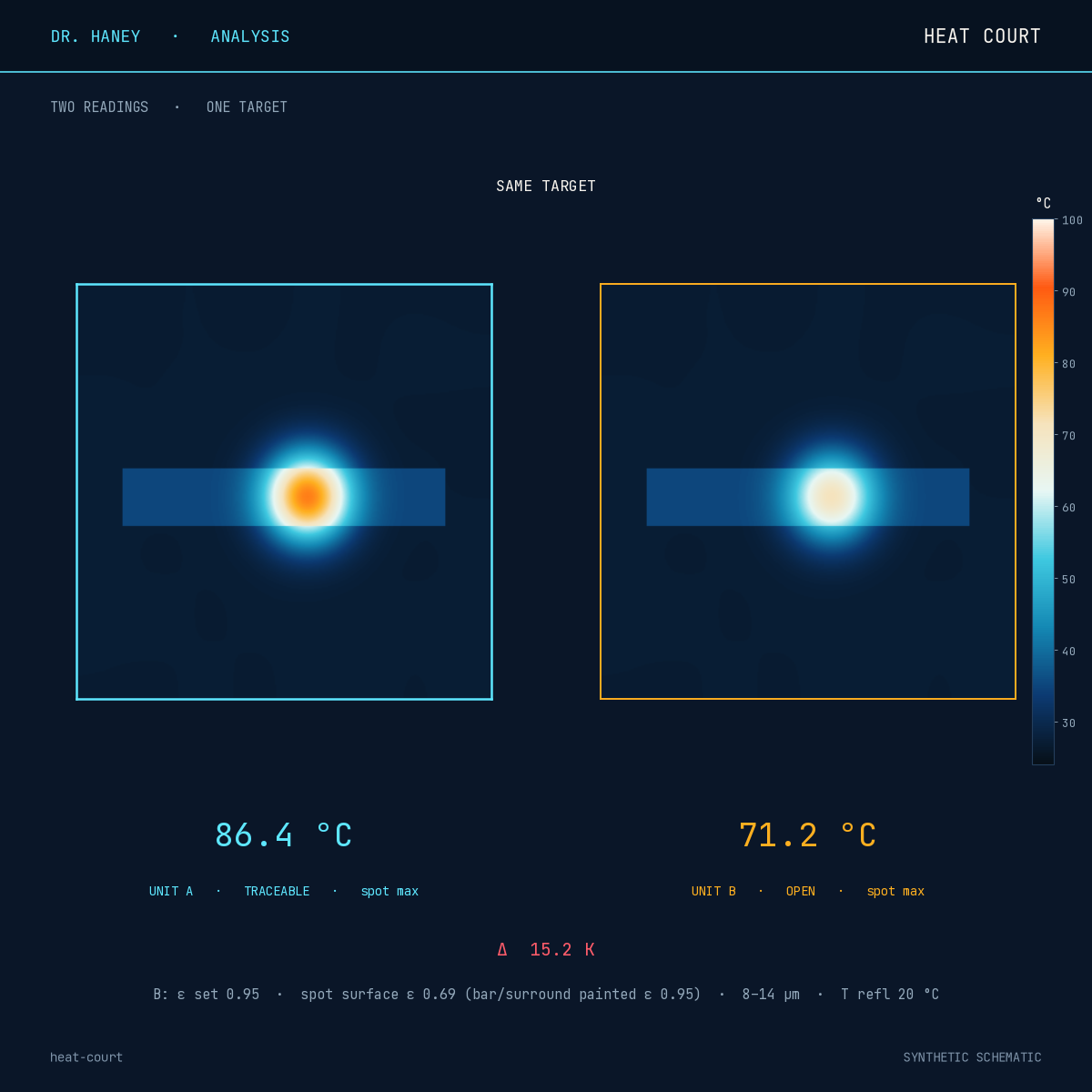
Two companies fight over an infrared reading. Send both sides’ infrared reading, the target, the conditions each side claims, and the exact point they dispute.
The deliverable is a full written report, naming which reading holds and why, limited to the materials sent. A testimony day is $24,000 and is not included in that report. The testimony day covers a deposition outside court or live testimony in court, scheduled separately. Not a mediation and not a new measurement campaign.
Measured quantity: the disputed infrared reading against the conditions each side claims. The report names which reading holds and why, limited to the materials sent.
03 · Measurement checks
Each engagement delivers a full written report on the claim and the supporting data provided. The price is the report.
Spec truth
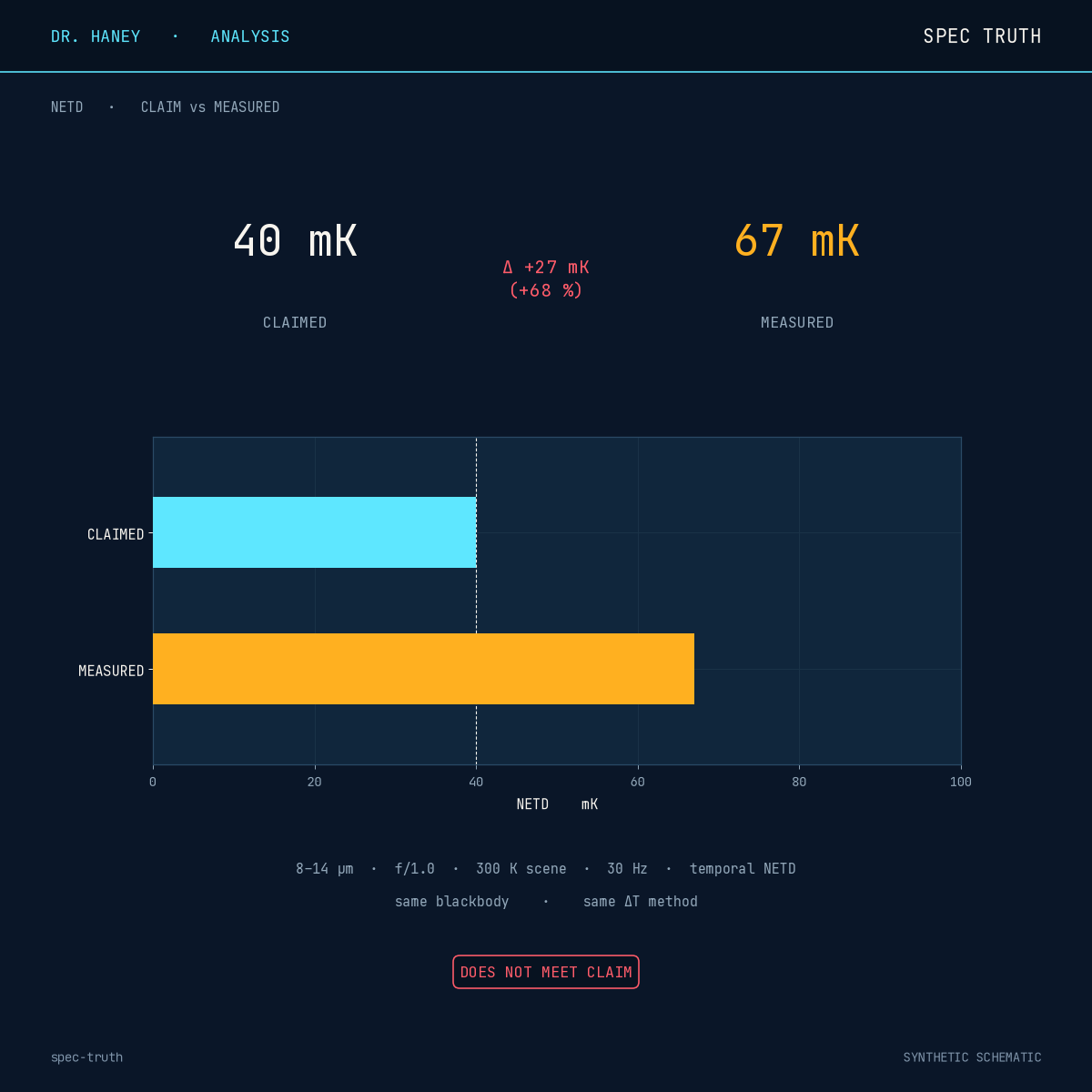
A camera maker claims a number. Send the claimed number, the quantity (NETD or whatever they name), the band, and the measurement or the camera data.
The deliverable is a full written report on whether the supplied measurement is consistent with the claimed spec, and what that measurement cannot show. A definitive true/false verdict requires a traceable blackbody measurement, which is still extra and is not included.
Measured quantity: the claimed camera number in the stated band. The report states whether the supplied measurement is consistent with that spec, limited to that measurement, and a traceable blackbody remains extra.
Range lie
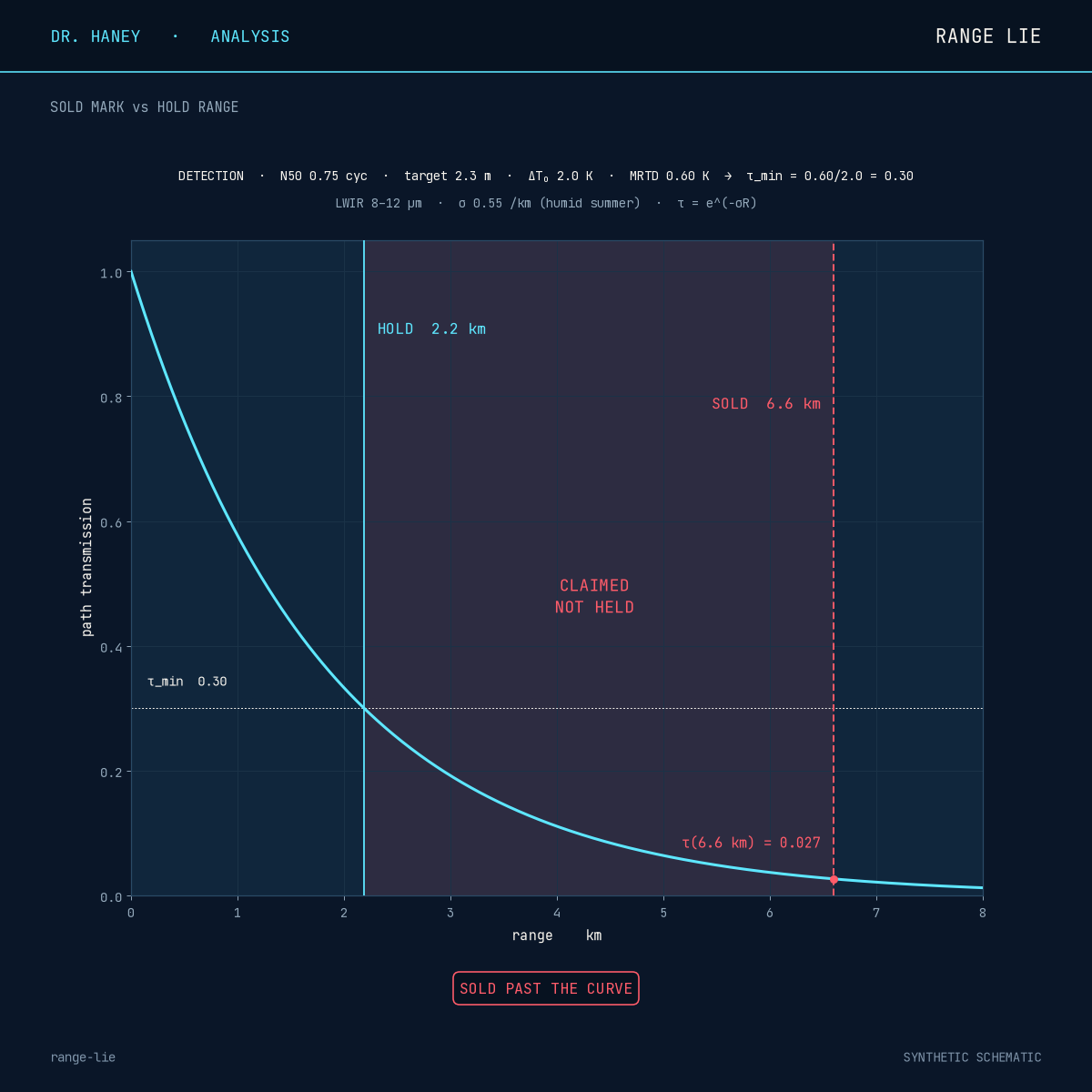
A system is sold as seeing a target at a stated distance. Send the stated detection distance, the target, the band, and the conditions they name: atmosphere, optics, detector, and criterion.
The deliverable is a full written report of the distance the supplied data supports under those conditions, and the gap versus the sold number. Not a field trial and not a lab accreditation. Separate from Range truth.
Measured quantity: the distance the supplied data supports under the stated atmosphere, optics, detector, and criterion. The report states that distance and the gap versus the sold number, and it is not a field trial.
Lens lie
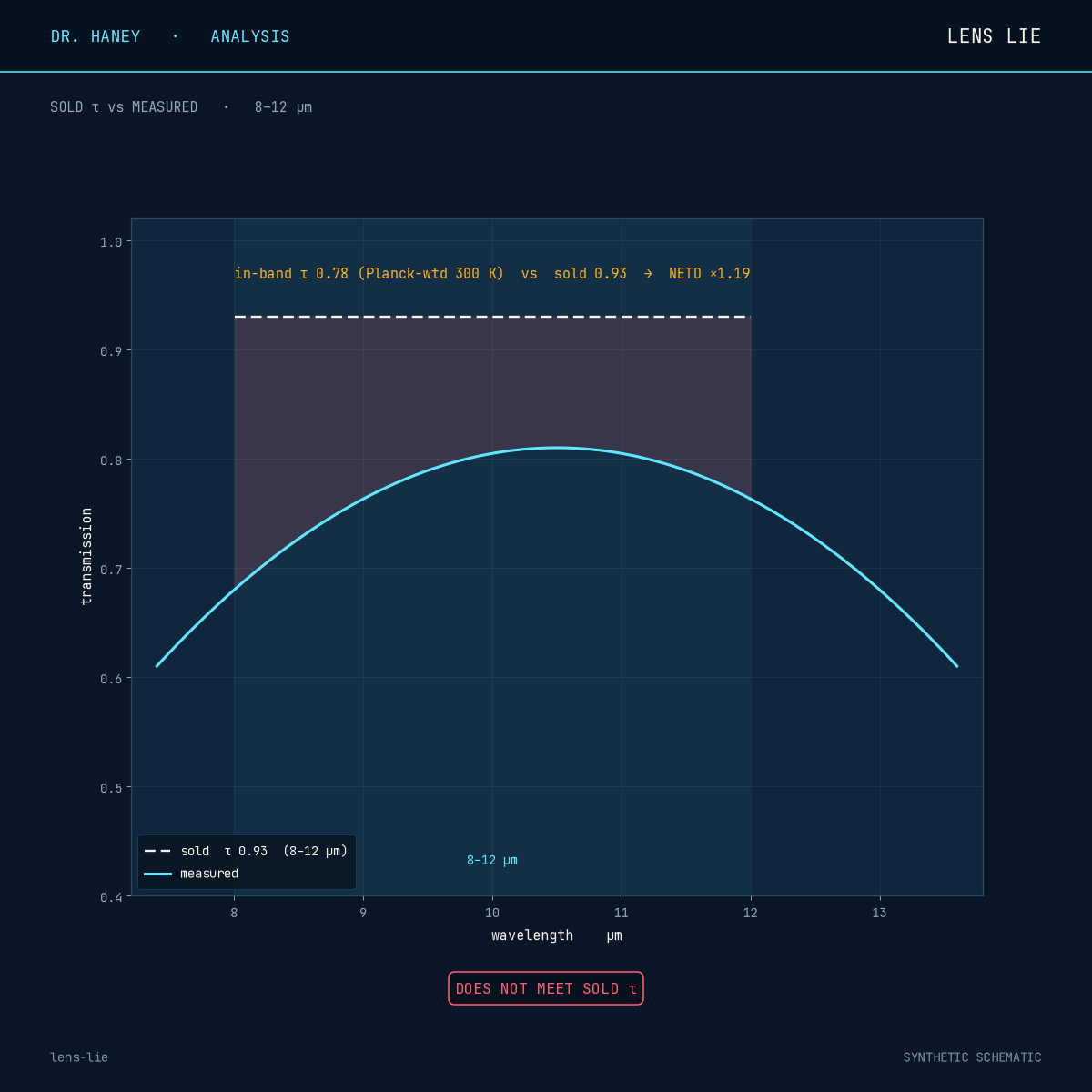
A lens is sold with a stated in-band performance. Send the sold lens numbers, the band, and the measurement offered as proof.
The deliverable is a full written report of the performance that data supports, and the gap versus the sold number. Not a lab accreditation.
Measured quantity: in-band lens performance against the sold numbers and the measurement offered as proof. The report states the performance that data supports and the gap versus the sold number, and it is not a lab accreditation.
Window truth
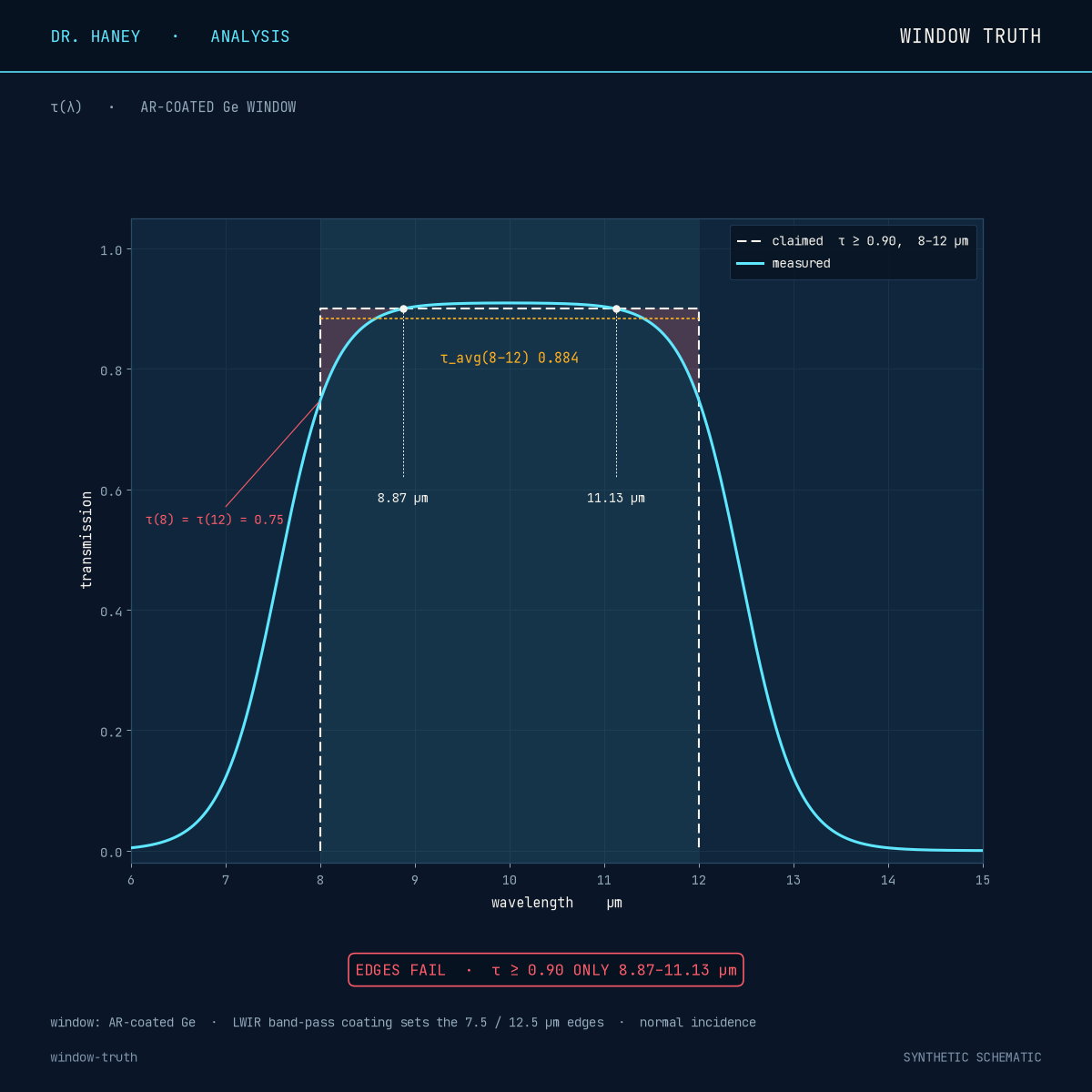
A window is claimed to pass a stated band. Send the claimed transmission or optical spec, the band, the window material, and the radiometric data that is supposed to show it.
The deliverable is a full written report on whether that spec holds in the supplied data, and what the data cannot show. Not a lab accreditation.
Measured quantity: transmission or optical spec in the stated band. The report says whether that spec holds in the supplied data and what the data cannot show, and it is not a lab accreditation.
Atmosphere cut
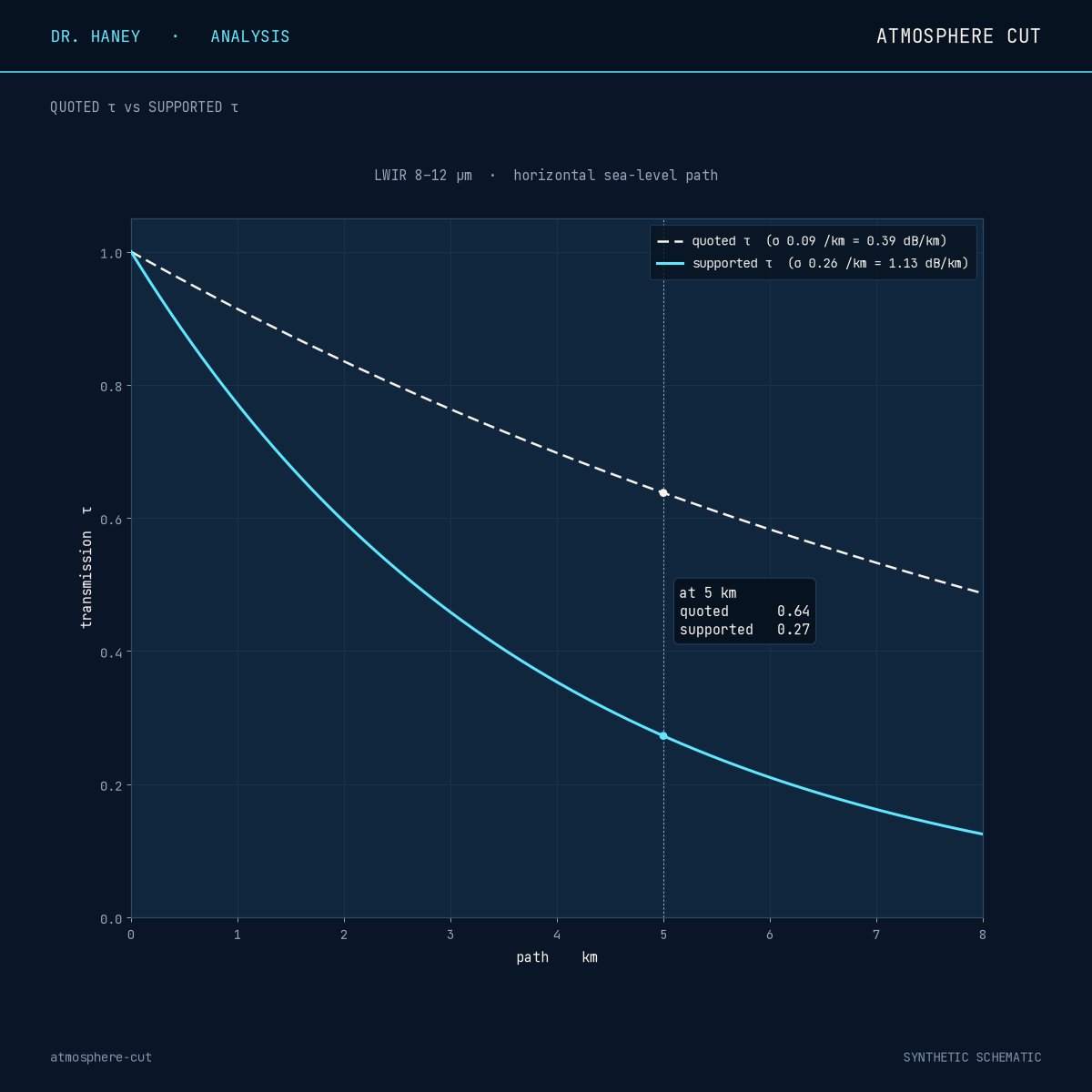
A path is quoted with a stated atmospheric loss. Send the band, the path, the atmosphere they name, and the measurement or transmission data.
The deliverable is a full written report of the cut those conditions support in the data, and the gap versus the number they used. Not a field trial.
Measured quantity: atmospheric loss on the stated path and band. The report states the cut the data support and the gap versus the number used, and it is not a field trial.
Handoff truth
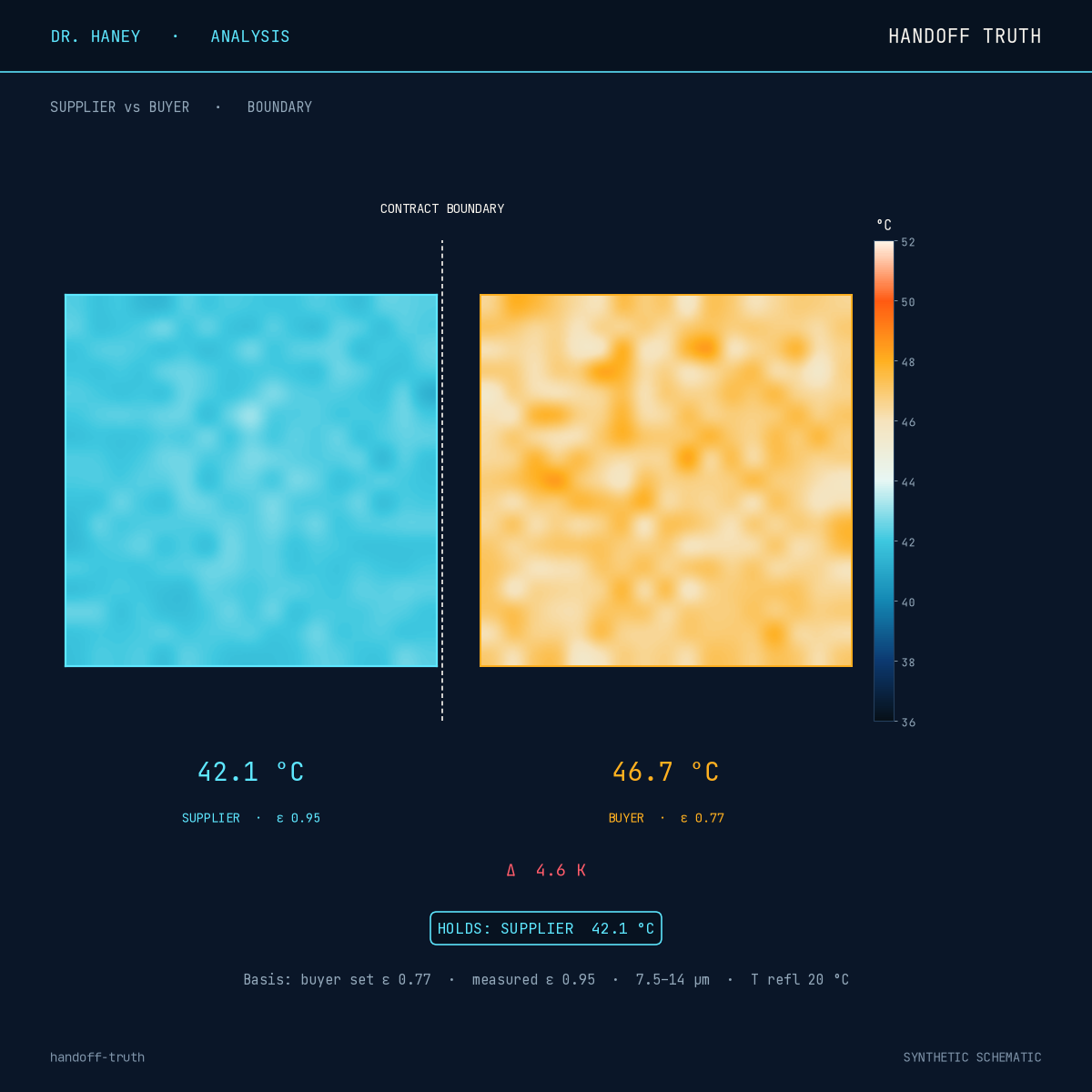
Supplier and buyer infrared numbers disagree at the contract boundary. Send both parties’ infrared numbers, the contract boundary they share, the target, the band, and the conditions each side claims.
The report says which number holds at that boundary, and why.
Lot truth
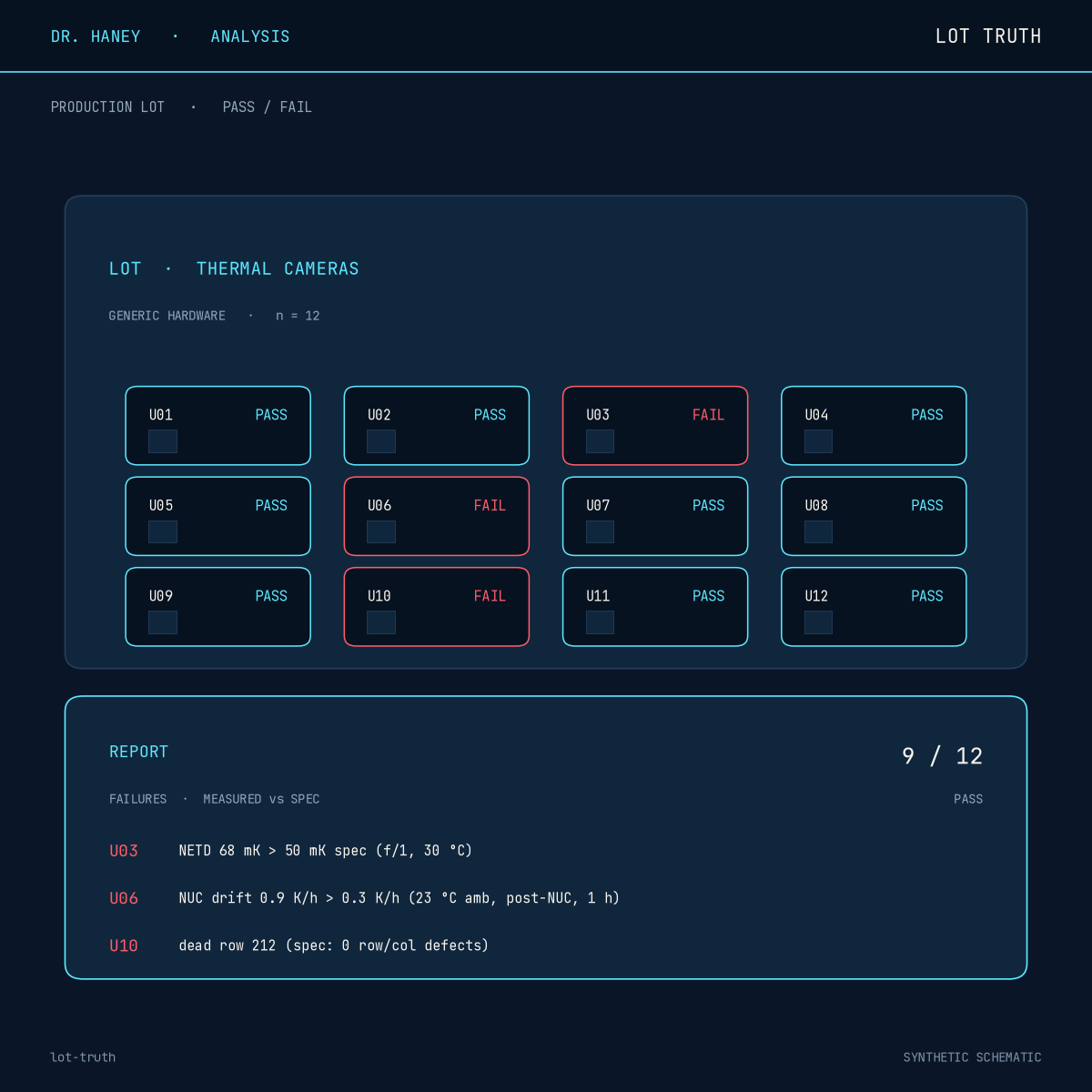
A production lot of cameras is reviewed against the stated specification. Send the stated specification, the lot size, the radiometric data for each unit, and how the sample was drawn.
The written report states whether the lot meets that specification, or it names the failures.
Dome truth
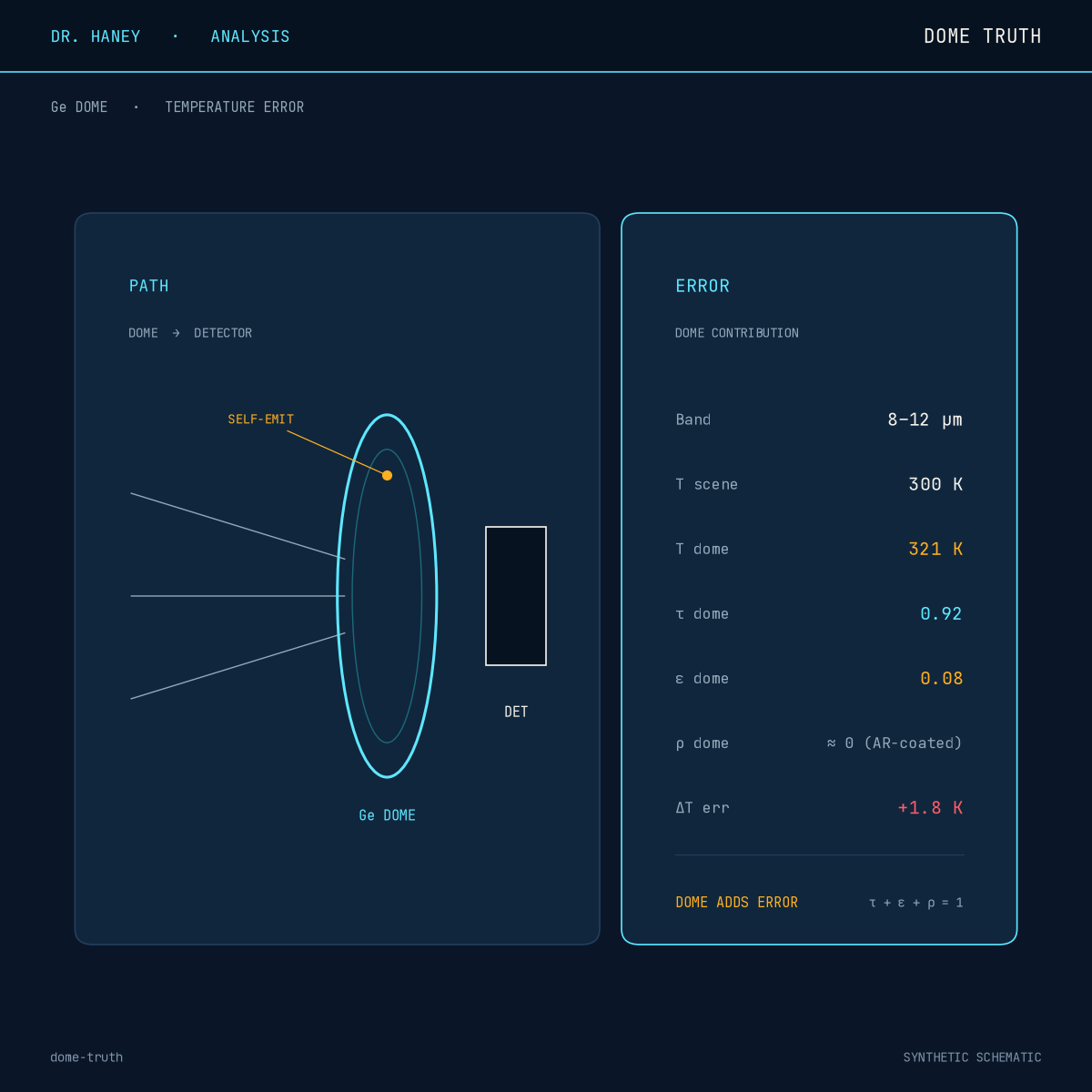
What a curved germanium dome does to the temperature. Send the dome geometry, the band, the temperature data with and without the dome, and the reference or blackbody readings.
The report states the temperature error the dome introduces.
Jitter truth
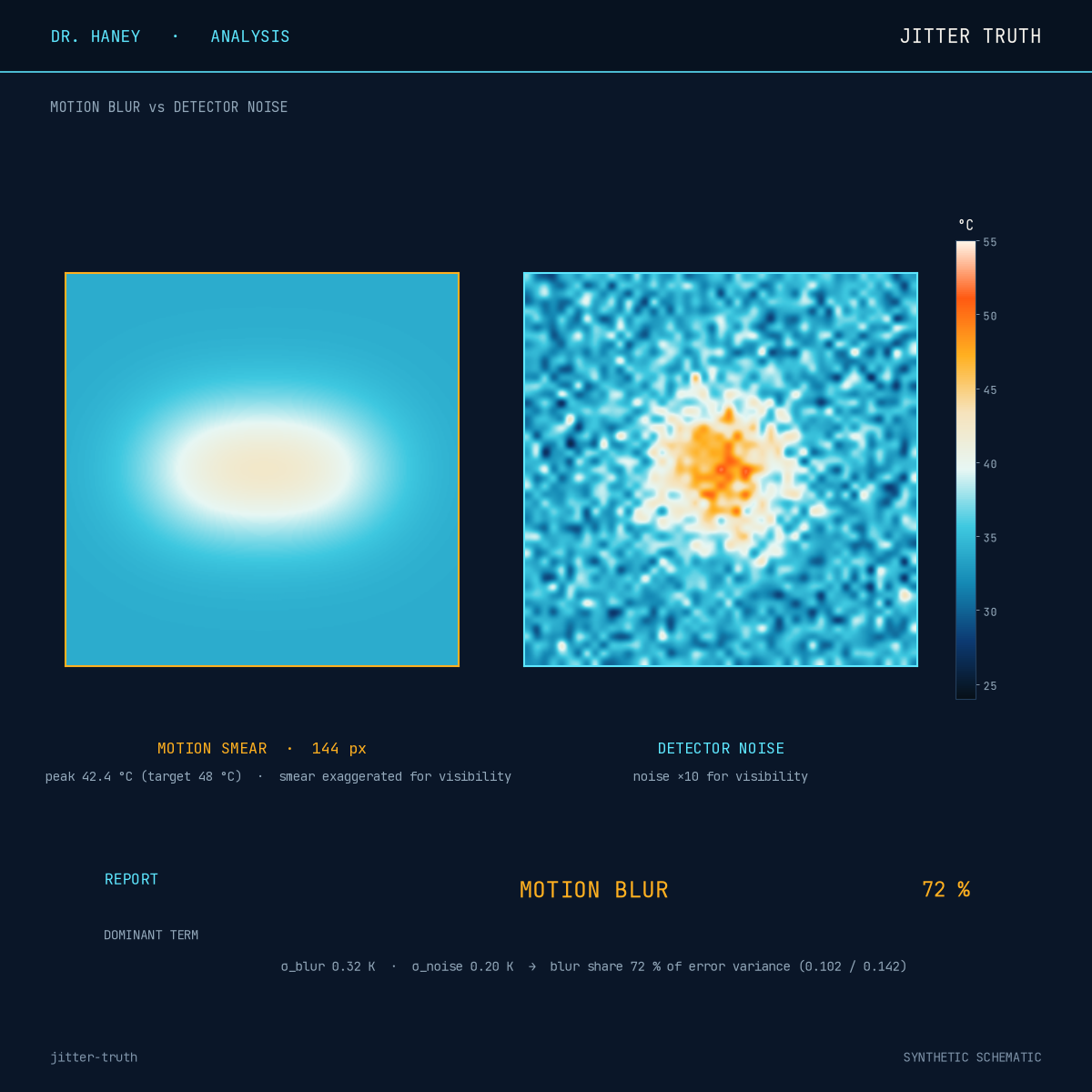
Separates motion blur from detector noise. Send the image or frame sequence, the exposure and frame rate, the band, and any platform motion data.
The report states which one dominates.
04 · Engineering advisory
Delivered personally by R. Lance Haney, Ph.D. (Materials Engineering, Auburn), a subject-matter expert in EO/IR sensors. AI tools may help with formatting and indexing; they make no findings and hold no credentials. A written conflict check comes first: no NDA, no data, and no payment until it clears. To start, email lance.haney@gmail.com with the company's legal name, product, customers (including any government customers and federal funding), investors, and whether any data carries an export-control marking. Pay only after written clearance; the checkout asks for that reference.
Fractional chief engineer
For seed-stage commercial drone, commercial space, and medical-device startups. Up to 5 hours per week plus a standing 30-minute weekly call, month to month.
Design reviews (concept, preliminary, and critical), drawing and BOM review, tolerance stack-ups, thermal and environmental margins, and test plans, each closed with a written note. Materials trade studies for alloys, polymers, composites, coatings, adhesives, and commercial optical materials. Supplier vetting: quality-system questionnaires, quote review, first-article inspection plans, and single-source risk. Core answers review requests within 5 business days; Priority within 2, and adds a monthly written technical risk register and one investor or board technical Q&A prep session per month.
Not included: regulatory submissions or signatory duties, lab testing or nondestructive testing, hiring decisions. Commercial-space work stays outside satellite RF/microwave payloads, ground stations, launch, and propulsion; drone work is commercial only, with no government customer. It is not a licensed engineering stamp and not a guarantee.
Not accepted: work for any company that competes with, or is a customer of, R. Lance Haney's current employer; any ITAR- or EAR-controlled technical data or other defense-sensitive work; anything involving weapons, weapon-delivery or high-speed flight vehicles, missile seekers, weapons guidance, targeting, or fire control; thermal-protection, propulsion, rocket-motor, or energetics work; tethered or military drones, counter-UAS, and surveillance payloads for government users.
Is this real? Technical due diligence
For angel groups, family offices, and small funds weighing a hardware or deep-tech deal. A one-week, firm fixed price full written report on the startup's core technical claims.
Physics check: whether the headline claims respect conservation laws, thermodynamic limits, and diffraction and detector-noise limits, and whether the numbers agree across the deck, data room, and patents. Materials check: whether the stated properties fit the materials and processes described. Manufacturability check: scale-up, yield, tolerances, cost-down assumptions, and supplier dependence. A red-flag register rated High / Medium / Low with the evidence for each, ranked questions for the founders, a founder interview, and an investor readout. Standard covers one core technology; Extended covers multi-subsystem hardware or several independent claims, two founder interviews, a manufacturing deep dive, and an investment-committee readout. Turnaround is 5 business days from conflict-check clearance and a complete data room.
The report is a technical opinion on the claims and evidence provided, and it says where evidence is missing. Not investment, legal, or financial advice, and not a valuation. Diligence on defense-market startups is declined. It is not a licensed engineering stamp and not a guarantee.
Not accepted: work for any company that competes with, or is a customer of, R. Lance Haney's current employer; any ITAR- or EAR-controlled technical data or other defense-sensitive work; anything involving weapons, weapon-delivery or high-speed flight vehicles, missile seekers, weapons guidance, targeting, or fire control; thermal-protection, propulsion, rocket-motor, or energetics work; tethered or military drones, counter-UAS, and surveillance payloads for government users.
SBIR/STTR Phase I proposal
Flat-fee Phase I proposals for small companies applying to NSF, NIH, DOE, NASA, or USDA, especially in materials, coatings, composites, photonics, and commercial EO/IR sensing. R. Lance Haney, Ph.D. writes the technical sections from PI interviews and data; the idea and the innovation belong to the client's PI, and the client submits.
Core: topic-fit review, compliance matrix, technical sections, formatting and page-limit check, one revision round. Full adds a second revision round, a commercialization section draft, a budget justification draft, a letters-of-support plan, and an NSF Project Pitch draft if needed. Kickoff at least 4 weeks (Core) or 6 weeks (Full) before the deadline.
No success fee and no percentage of any award. The fee is paid from the client's non-federal funds, is due whether or not the proposal is funded, and is never charged to a federal award. DoD topics are not offered. No proposal is guaranteed to be funded. It is not a licensed engineering stamp and not a guarantee.
Not accepted: work for any company that competes with, or is a customer of, R. Lance Haney's current employer; any ITAR- or EAR-controlled technical data or other defense-sensitive work; anything involving weapons, weapon-delivery or high-speed flight vehicles, missile seekers, weapons guidance, targeting, or fire control; thermal-protection, propulsion, rocket-motor, or energetics work; tethered or military drones, counter-UAS, and surveillance payloads for government users.
FTIR gas-analysis model building
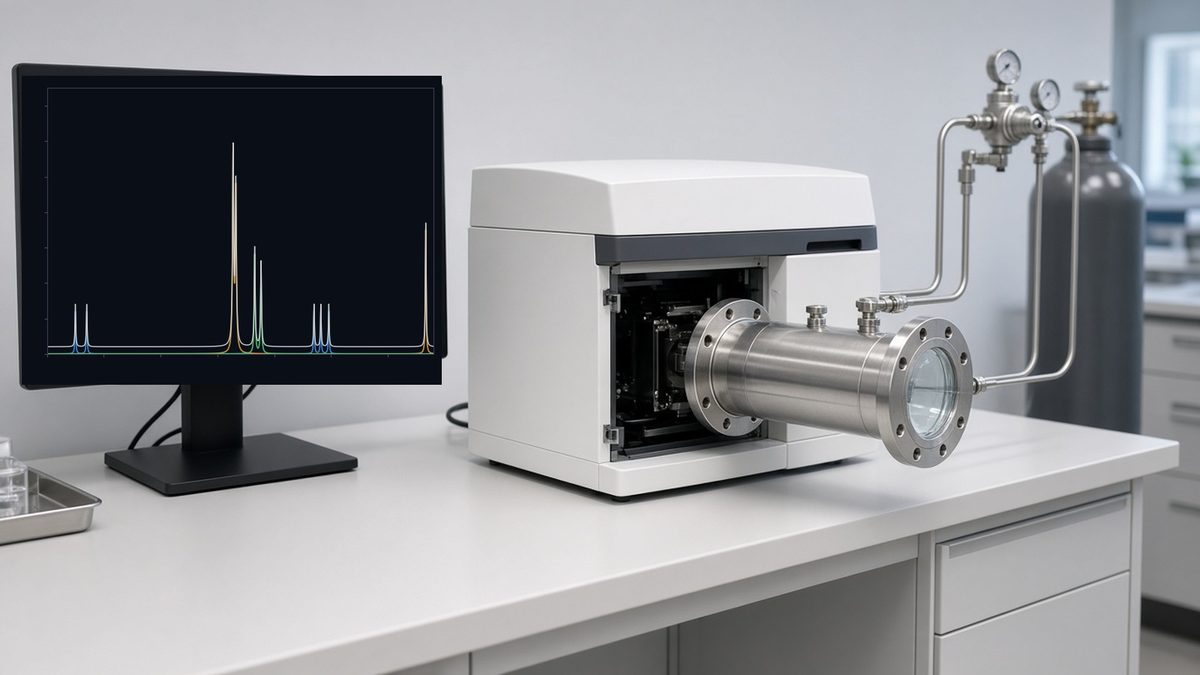
For emissions and stack-testing groups, semiconductor fabs, VPHP decontamination teams, and gas-sensor startups running FTIR. Send your gas spectra and reference concentrations, and get back a validated PCA/PLS/PCR calibration that handles water and other interferences.
Delivered remotely with an RMSEC/RMSECV/RMSEP table, a model file with a script to apply it, and a full written report on methods, decisions, and limits. Standard covers one gas matrix, up to 3 analytes, and one instrument configuration in 15 business days; Full covers up to 6 analytes or 2 instrument configurations, a comparison of interference strategies, and a robustness check in 25 business days. 50% due at kickoff, 50% on delivery.
Model performance is limited by the quality and range of the data supplied. It is not a licensed engineering stamp and not a guarantee.
Not accepted: work for any company that competes with, or is a customer of, R. Lance Haney's current employer; any ITAR- or EAR-controlled technical data or other defense-sensitive work; anything involving weapons, weapon-delivery or high-speed flight vehicles, missile seekers, weapons guidance, targeting, or fire control; thermal-protection, propulsion, rocket-motor, or energetics work; tethered or military drones, counter-UAS, and surveillance payloads for government users.
Metal true-temperature measurement audit
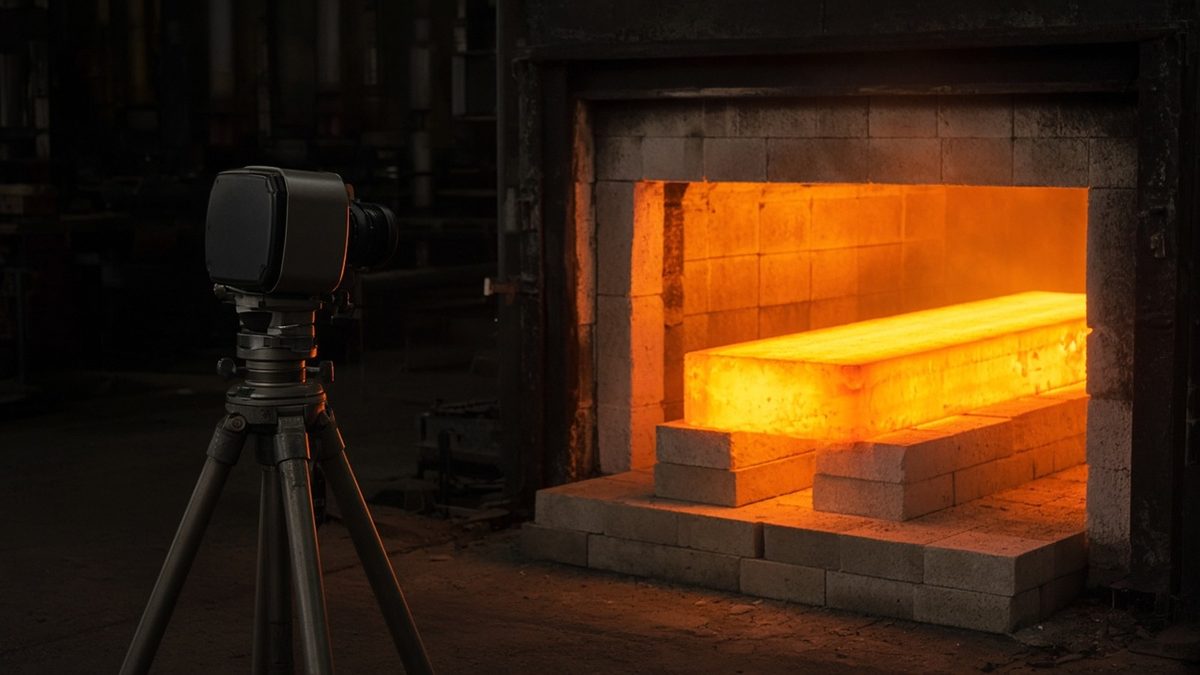
For metal additive manufacturing, heat-treat, welding automation, and forging shops. An independent remote review of the pyrometer or IR camera you already use, covering band choice, emissivity, reflections, calibration, and uncertainty, so you know how close your reported temperature is to the true metal temperature.
You get a quantified uncertainty budget and a full written report with prioritized recommendations, limited to standard, commercially available practice. Standard covers one process, one instrument, and one alloy family in 10 business days; Full covers up to 3 instruments or stations, or 2 alloy families, plus a recommended measurement procedure, in 20 business days. 50% due at kickoff, 50% on delivery.
Findings depend on the information and data supplied. It is not a licensed engineering stamp and not a guarantee.
Not accepted: work for any company that competes with, or is a customer of, R. Lance Haney's current employer; any ITAR- or EAR-controlled technical data or other defense-sensitive work; anything involving weapons, weapon-delivery or high-speed flight vehicles, missile seekers, weapons guidance, targeting, or fire control; thermal-protection, propulsion, rocket-motor, or energetics work; tethered or military drones, counter-UAS, and surveillance payloads for government users.
05 · FTIR toolkit
Software, data, a fixed-fee service, and a course for gas-phase FTIR, by R. Lance Haney, Ph.D. Everything here is built on a HITRAN line-by-line forward model (Voigt line shapes, temperature-scaled line intensities, the instrument line shape applied in transmittance) with an ideal instrument. Every number it produces is a simulation estimate, not a measurement. Simulated detection limits are lower bounds: they leave out interferents, baseline drift, purge residuals, and reference mismatch. Line data: I. E. Gordon, L. S. Rothman, R. J. Hargreaves, et al., "The HITRAN2024 molecular spectroscopic database," J. Quant. Spectrosc. Radiat. Transfer 353, 109807 (2026).
FTIR detectability checker
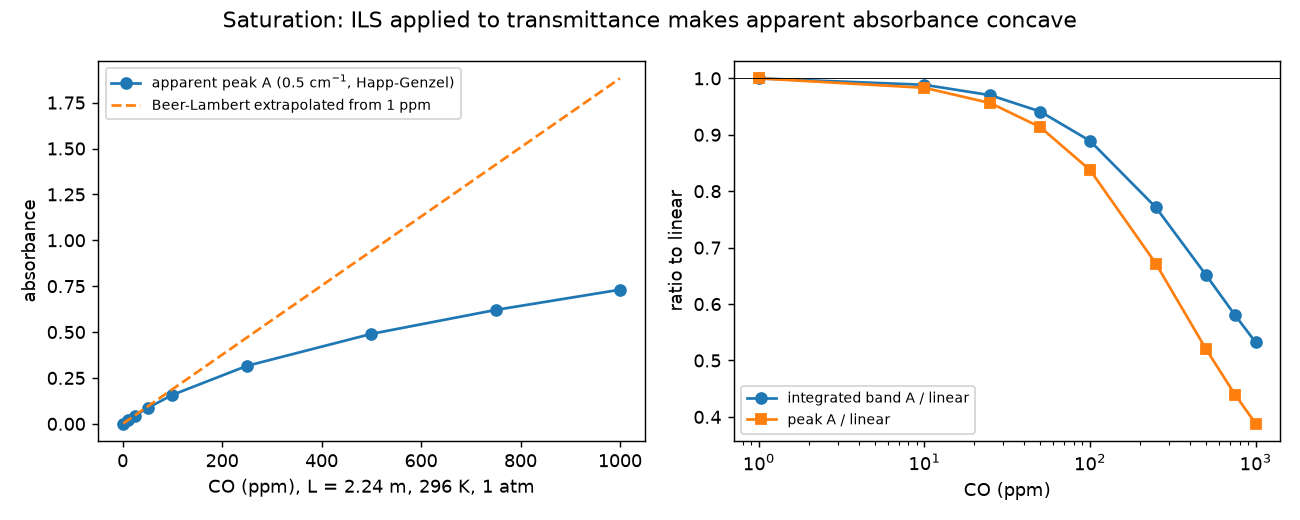
"Can my gas cell see this species at this concentration?" Enter the species (CO, CO2, H2O, CH2O, CH4, CH3OH, H2O2), concentration, path length, temperature, pressure, resolution, apodization, and noise level. The checker returns the line-centre optical depth of the strongest line, a linearity flag (apparent absorbance more than 5% below Beer–Lambert, or optical depth above 5), and an estimated 3.3σ detection limit that is a lower bound.
The single-species checker is free and public: ftir-detectability-checker.vercel.app. The paid plans are sold through Stripe for now. After purchase, access is set up by email. There is no login or paid-only feature on the site yet.
It is not a licensed engineering stamp and not a guarantee.
Fume spectra library (SIMULATED)
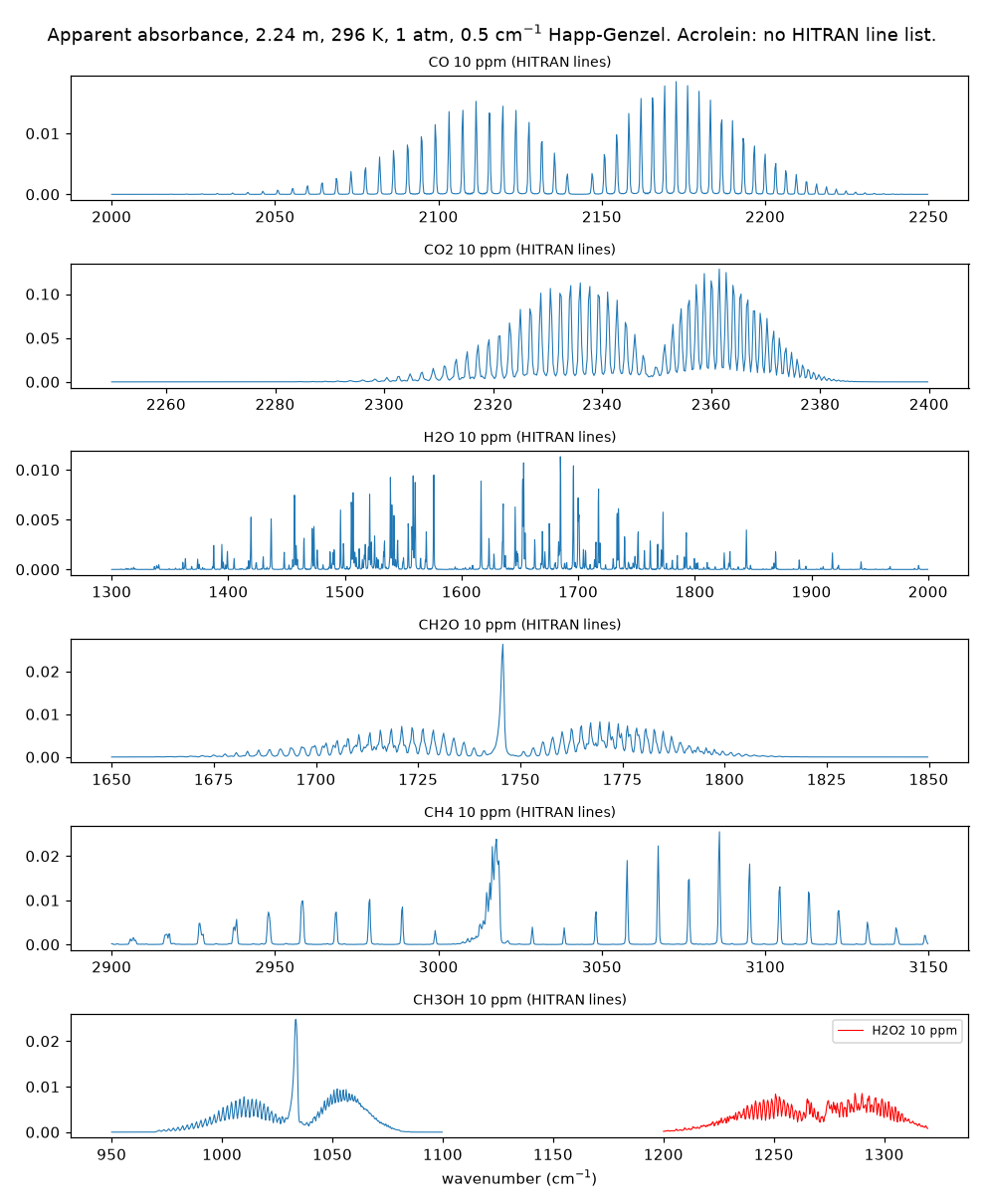
These are SIMULATED reference spectra, not measured spectra. The library holds 756 spectra of CO, CO2, H2O, CH2O, CH4, CH3OH, and H2O2, calculated from HITRAN2024 line parameters for an ideal instrument. The grid covers 273–323 K at 1 atm, 2.24 m and 10 m paths, 0.5–2 cm⁻¹ resolution, and Happ-Genzel and boxcar apodization. Absorbance is decadic, computed as −log₁₀ of the instrument-convolved transmittance. Files come in JCAMP-DX and NumPy formats with an index and SHA-256 hashes. The library also includes two PLS models (CH2O in H2O/CH4 and CO in H2O/CO2), each with a validation record whose figures of merit are also simulated.
The site license is a one-time fee. Annual updates add new releases and email support. Custom configuration regenerates the library at your path, temperature, pressure, and resolution, and refits the models. Spectra are principal-isotopologue only, with no line mixing or continuum. Species without HITRAN line lists, such as acrolein, are not included. It is not a licensed engineering stamp and not a guarantee.
FTIR calibration design and validation
A fixed-fee service that designs a multicomponent gas-FTIR calibration or audits an existing one. It addresses the common failure modes: standards with correlated concentrations, components chosen by a variance threshold instead of by validation, saturated lines treated as linear, and figures of merit reported without an independent test set. Every project ends with a full written report.
Tier A (Design): up to 4 analytes and one instrument configuration. You get an uncorrelated design of standards and run order, a path, resolution, and apodization recommendation that keeps the analytes in the linear range, simulated performance estimates, and an interference map. Tier B (Design + Audit): everything in A plus an audit of one existing dataset of up to 300 spectra (cross-validation, independent-test error, component selection, nonlinearity, and outlier review). Tier C: everything in B for up to 6 analytes, plus one revalidation round on new data you collect.
The conflict check comes first, as for the advisory services above. Pay only after the conflict check is approved in writing; the checkout asks for that reference. Predicted performance is a simulation estimate, and simulated detection limits are lower bounds. It is not a licensed engineering stamp and not a guarantee.
ftirtools package license
A commercial license for ftirtools, the Python package behind everything in this toolkit. It covers HITRAN line-by-line gas-cell simulation, the instrument line shape and apodization, and chemometric calibration (PLS, PCR, CLS, and MCR-ALS), with versioned HITRAN-derived data and a provenance file. Team: internal use for up to 10 named developers, all releases during the term, and email support. OEM / redistribution: embedding and distribution in your product (up to 500 units a year), the long-term-support branch, and priority support. A free 30-day evaluation is available by email.
All outputs are simulation estimates. It is not a licensed engineering stamp and not a guarantee.
FTIR chemometrics course
Eight modules on quantitative gas-phase FTIR: HITRAN line physics and units; optical depth, saturation, and the Beer–Lambert limit; instrument line shape, resolution, and apodization (convolved in transmittance); noise, co-adding, and detection-limit lower bounds; uncorrelated calibration design; CLS, PCR, and PLS with components chosen by cross-validation; validation with independent test sets, outlier diagnostics, and nonlinearity tests; and MCR-ALS, including why loadings are not spectra. Each module includes an executed Python notebook built on ftirtools and a quiz, and the course ends with a capstone. Every exercise spectrum is SIMULATED.
Self-paced seats include the notebooks, quizzes, and a self-checked capstone rubric. The video lectures are still in production. Live cohorts run 6 live sessions with capstone review, up to 12 seats. Private group or university cohorts take up to 20 participants. Course dates are confirmed by email after purchase.